
Shopware vs. Salesforce Commerce Cloud
Discover a modular, open-source ecommerce platform. Stay in full control of your online store and tailor it to your exact business needs. Here’s what truly matters in a Shopware vs. Salesforce Commerce Cloud comparison.
Trusted by leading global enterprise brands
We support thousands of businesses worldwide in succeeding in digital commerce. Earning and maintaining your trust is our highest priority.



Shopware vs. Salesforce Commerce Cloud – at a glance
Shopware | Salesforce Commerce Cloud | |
|---|---|---|
Deployment | PaaS or self-hosted – your choice of provider | Proprietary SaaS, hosted by Salesforce |
Licensing model | Package pricing (Shopware Rise, Shopware Evolve, Shopware Beyond) | Revenue-based (1–2% GMV), partly custom offers¹ |
Architecture | API-first, modular, open source | API-first, proprietary, platform-bound |
CMS integration | Integrated CMS with Shopping Experiences | No fully native CMS – often requires external headless solutions |
Customization | Full source code access, strong developer community | Customizations via Salesforce’s proprietary dev framework (ISML, etc.) |
Support model | 24/7 support, follow-the-sun available | Enterprise support with SLAs, add-ons available |
Scalability | Vertical and horizontal scaling | Scaling via Salesforce cloud infrastructure |
Data ownership | Hosting choice ensures full data control | Data stored within Salesforce cloud – platform-controlled |
Development resources | Large open-source community, extensive agency network | Salesforce-specific skills required |
Why choose Shopware?
Shopware provides a flexible ecommerce platform that adapts to different business models and infrastructures. This gives you maximum flexibility and technical independence.

Full control over your infrastructure
Choose between SaaS, PaaS, or self-hosted. You remain in control of your server environment, deployment strategy, and security requirements.

Customizable commerce architecture
Thanks to its modular structure and API-first approach, Shopware lets you implement your specific business logic. You decide which features you use and how your ecommerce platform evolves.

Flexible data storage
Whether in your own cloud environment or with a provider of your choice – Shopware gives you full control over where your data is stored. This makes it easier to meet internal compliance standards and global data privacy regulations.

Built for performance and scalability
With infrastructure-level flexibility and a sophisticated caching system, Shopware delivers fast load times and stable growth – even during peak traffic periods.
Platform GMV in 2025
Extensions in the Shopware Store
Partners worldwide
Freedom in payment providers. Transparent cost structure – no vendor lock-in.
Market leaders rely on Shopware to drive innovation and increase revenue
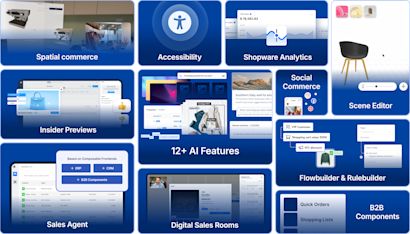
Discover features that give you real freedom to design and grow your business – B2B, B2C, or D2C. Combine flexible building blocks to create the setup that fits your strategy. The modular architecture allows you to implement new requirements faster and more efficiently.
Shopware vs. Salesforce – hosting differences
Self-hosted, PaaS, or SaaS – with Shopware, you decide. Choose the deployment model and cloud provider that best fits your business. You stay flexible – and we stay open. Salesforce Commerce Cloud is available exclusively as a SaaS solution. There is no self-hosted or PaaS option.

SaaS

PaaS

Self-hosted

Shopware vs. Salesforce – frequently asked questions
What is the difference between Shopware and Salesforce Commerce Cloud?
Shopware is a modular ecommerce platform with an open-source core and multiple deployment options, including SaaS, PaaS, and self-hosted. Salesforce Commerce Cloud is a pure SaaS offering where infrastructure and updates are fully managed by the provider.
Can Salesforce Commerce Cloud be self-hosted?
No. Salesforce Commerce Cloud is only available as a SaaS solution and is centrally hosted by Salesforce. Shopware also supports self-hosted and PaaS models, giving businesses greater control over infrastructure and data.
Which platform offers more control over source code?
Shopware provides access to its open-source core, enabling deep customization. Salesforce Commerce Cloud does not provide access to the underlying platform logic, as it operates as a proprietary system.
How well can third-party systems be integrated?
Both platforms support integrations with ERP, CRM, and PIM systems. Shopware’s API-first architecture enables seamless integrations and a highly customizable system landscape with full extensibility.
Take control of your architecture and infrastructure with Shopware
Many ecommerce projects fail due to technical limitations. Shopware gives you direct access to the source code, a transparent architecture, and full freedom in hosting decisions. Let’s explore how your project can be realized – technically and strategically.