PartsTree rebuilds a legacy ecommerce ecosystem with Shopware to support massive scale and complex product data



Faits clés:
Version de Shopware
Entreprise
Fonctionnalités
Fonctionnalités techniques
Avantages de Shopware:


Et ensuite ?
Rebuilding Commerce for a Highly Specialized Business
A division of Hill Country Outdoor Power, PartsTree operates at the intersection of ecommerce and technical product discovery. As a supplier of replacement parts for outdoor power equipment, the company serves both individual consumers and professional repair businesses with a catalog that spans millions of components across hundreds of brands.
What sets PartsTree apart is not just the scale of its catalog, but the way customers interact with it. Rather than browsing traditional product categories, users begin with a specific piece of equipment, navigating through detailed exploded parts diagrams to identify and purchase the exact component they need, often down to an individual bolt or washer. This workflow allows customers to move from diagnosis to order in a single, seamless experience.
For more than two decades, this experience was powered by a custom-built system. Over time, however, that system became increasingly difficult to scale, maintain, and adapt.
When a Legacy System Becomes a Constraint
PartsTree's previous platform was not a commercial ecommerce solution. It was a custom-built ecosystem developed over 25 years, designed to support a unique data model and customer experience.
At its core was an unstructured database that had been continuously modified to accommodate new brands, products, and edge cases. While this approach provided flexibility early on, it also introduced significant challenges. Much of the system's business logic was undocumented, and inconsistencies in product data, naming conventions, and relationships had accumulated across hundreds of manufacturers.
As a result, even basic changes became difficult to implement. Scaling the system to support new brands, markets, or business models was increasingly impractical. At the same time, PartsTree's growth trajectory, supported in part by private equity investment, required a more modern, scalable foundation that could seamlessly integrate new brands, expand SKU counts, and address potential roll-up opportunities. The company needed a platform capable of supporting not only its existing complexity, but also its future ambitions.
Transforming Millions of Products and Relationships
The defining challenge of the project was the sheer scale and structure of PartsTree's data. The catalog includes 4.4 million products, 462,000 equipment model categories, and 1.5 million exploded parts diagrams (IPLs). These diagrams connect individual components to specific models, creating a dense network of relationships. Including all relationship mappings and supporting entities, the system encompasses nearly 300 million database entities.
Migrating this data required bridging two fundamentally different systems. The legacy environment relied on an unstructured document database, while Shopware uses a structured MySQL database.
The complexity was further compounded by inconsistencies across manufacturers. Each brand defined products differently, using its own conventions for part numbers, attributes, and categorization. Many edge cases and data exceptions surfaced only during ingestion, requiring continuous refinement of the mapping logic.
Importantly, the legacy system remains the active source of truth for PartsTree's catalog operations. A custom sync integration listens for changes there and continuously updates Shopware's MySQL database, ensuring the new storefront always reflects the latest product data. Rather than a one-time migration, the process became an iterative effort of discovery and refinement.
Designing a Non-Traditional Ecommerce Experience
A central requirement of the project was preserving and enhancing PartsTree's diagram-based product discovery experience. Unlike standard ecommerce platforms where products are organized into categories and filtered by attributes, PartsTree's experience begins with a specific piece of equipment.
This approach required a fundamentally different data model. The implementation introduced custom entities for diagrams and their relationships to products and equipment models. Categories were repurposed as organizational structures for equipment rather than traditional merchandising hierarchies. These adaptations allowed Shopware to support PartsTree's specialized experience while maintaining the performance and flexibility of a modern ecommerce platform.
A Platform Built for Flexibility and Control
Following a structured evaluation process that included multiple vendors, PartsTree selected Shopware based on its flexibility, extensibility, and strong administrative capabilities. Key differentiators included the platform's ability to accommodate custom data models and its rule-based automation tools.
Shopware's Rule Builder and Flow Builder played a critical role in replacing complex custom logic. For example, PartsTree manages a highly detailed shipping matrix, essentially a 300-line spreadsheet of logic, with numerous variables including geography, customer type, delivery constraints, and carrier availability. Instead of hardcoding these rules, the team implemented them within Shopware's rule engine, allowing business users to manage and update logic without development support.
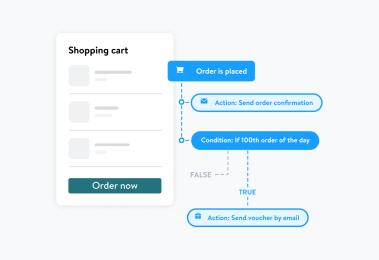
Similarly, order workflows were automated using Flow Builder, enabling dynamic routing, validation, and exception handling based on predefined conditions. This shift significantly reduced reliance on development resources and improved operational agility.
Building a Modern, Integrated Architecture
The new solution combines a headless storefront with Shopware's backend, supported by a middleware layer that continuously synchronizes data from the legacy catalog system. While the legacy system remains the source of truth for product data, the new architecture enables that data to be structured, enriched, and presented within a modern ecommerce framework.
PartsTree migrated from a custom-built legacy system to Shopware, transforming 6.5M products and complex diagram-based data (100M total association records) into a scalable, modern ecommerce platform. The migration also preserved continuity for PartsTree's existing customer base. Approximately 700,000 legacy customer accounts were migrated to Shopware, including stored addresses, preserved login credentials, and Braintree payment tokens. This enabled a seamless transition. Customers could log into the new site with their existing credentials and see their full account history intact.
Key integrations include a custom Braintree payment implementation, which also enabled new wallet payment methods like Apple Pay, Google Pay, and PayPal that PartsTree could not previously offer. Additional integrations include tax calculation via TaxJar, real-time shipping and address validation through UPS, USPS, and FedEx, and search powered by OpenSearch. Hosting is provided by Webscale, another key partner in the migration process.
"We would come up with 'here's the thing we want to do' and Webscale would help us figure it out. We would work together to divide, define the strategy and build the pieces. There was some debugging and some testing and some code writing, all teams sharing the responsibility." — Sam Bogart, Ecommerce Director, Altus Nova
A Collaborative Implementation
The project was completed over approximately ten months, following an initial planning phase that included roadmap development, requirements gathering, and system design.
Given the complexity of the data and the uniqueness of the business model, the implementation required close collaboration between PartsTree, Altus Nova, Shopware, and supporting technology partners. Although Altus Nova was implementing Shopware for the first time, the Shopware team provided proactive code reviews and architectural guidance throughout the engagement.
"Shopware was absolutely committed to making this very successful, actively taking things and making changes back to the core code, actively building plugins for us so that we were not having to customize core code, pushing on their extension partners to make updates to the plugins that we needed, being on calls on a weekly basis, being on a shared Slack channel daily. Having interactions with them was extremely valuable to this whole process." — Chris Hedge, Product Officer, Altus Nova
Teams worked together in real time to address data inconsistencies, infrastructure requirements, and technical challenges. This collaborative approach was essential to navigating the project's complexity and ensuring a successful outcome.
From Manual Processes to Operational Agility
While the platform is currently in a controlled, soft-launch phase ahead of the peak spring season, the impact on internal operations is already clear. Previously, even minor site changes required development work. Today, many of those changes can be managed directly by business users through Shopware's administrative tools.
This shift dramatically increases the speed at which PartsTree can adapt its ecommerce experience, update business rules, and respond to customer needs. The new platform also provides a stable foundation for handling large volumes of data and traffic, particularly during peak seasonal demand.
A Foundation for Growth and Expansion
With its new platform in place, PartsTree is positioned to expand both within and beyond its current market. Planned initiatives include deeper investment in B2B capabilities, enabling more advanced workflows for professional customers such as repair businesses and fleet operators.
The company also intends to explore multi-site and multi-brand strategies, creating tailored experiences for specific manufacturers or product lines. Beyond outdoor power equipment, the platform opens the door to expansion into adjacent categories that share similar complexity, potentially other parts-driven industries like automotive or marine components.
By replacing a fragmented legacy system with a modern, scalable architecture, PartsTree has transformed its ecommerce platform into a foundation for long-term growth.
Fonctionnalités utilisées dans ce cas
Découvrez la puissance des fonctionnalités innovantes de Shopware - le cœur de notre solution unique. Découvrez quelles fonctionnalités notre client a réussi à utiliser dans son propre cas. Plongez plus profondément dans les détails et utilisez cette inspiration pour votre propre projet.
Rule Builder
Define rules using conditions with the Rule Builder. Control pricing, shipping costs, promotions, and other logic.
Découvrez-en plus sur Rule Builder
Flow Builder
Automate business processes with the Flow Builder in one intuitive interface. Create workflows for tasks triggered by events without writing code.
Découvrez-en plus sur Flow Builder