



In March, my feed has been full of posts celebrating the "death of Agentic Commerce." The trigger: OpenAI scaled back native Instant Checkout inside ChatGPT, choosing instead to route purchases through merchant apps and existing retailer systems.
Some interpreted this as proof that the entire idea of AI-driven commerce was a mirage. I think this interpretation fundamentally misses what is actually happening and more importantly, where the real disruption sits in the stack.
What OpenAI actually changed
OpenAI moved checkout out of the chat interface and back into connected merchant environments. Users still discover products inside ChatGPT, but transactions now complete inside merchant systems.
The reasons are practical: user behavior patterns, integration complexity at global scale, fraud and compliance requirements, real-time inventory and tax infrastructure. In short, checkout is hard infrastructure, and building a full commerce engine inside a conversational interface overnight was always ambitious.
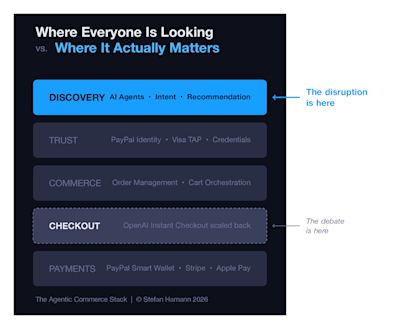
So yes, Instant Checkout was scaled back. But if you think that means Agentic Commerce is over, you are looking at the wrong layer.
The disruption was never about checkout
For twenty years, digital commerce followed a predictable architecture: discovery leads to a website, which leads to checkout. And discovery was controlled by three gatekeepers: search engines, marketplaces, and social platforms. SEO and paid advertising determined who was visible and who was not.
That architecture is now quietly breaking apart. Not because checkout changed, but because discovery moved.
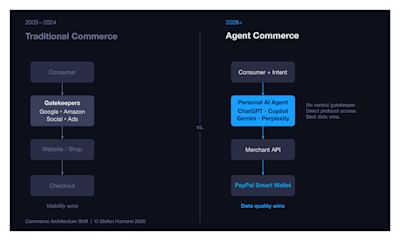
Consumers no longer start their buying journey with a search engine query. They start with AI. They ask ChatGPT, Perplexity, Copilot, or Gemini things like "What is the best laptop for travel?" or "Find me a good espresso machine under 800 euros." These systems do not return a list of links. They interpret intent, evaluate options, and decide which merchants even appear in the conversation.
That is the shift that matters. Not where the payment happens, but who decides which merchant gets considered in the first place.
From visibility to machine-readability
This is exactly what I have been arguing for over a year. In my Strategy Book "How Commerce Survives 2030," published in January 2026, I described the central thesis: market power in commerce is no longer created through visibility. It is created through machine-readability.
The old gatekeepers, search engines, ad networks, marketplaces, are transforming. In their place, AI systems are becoming the new distribution layer, and these systems do not optimize for design, landing pages, or creative copy. They optimize for structured data, trust signals, response speed, and machine-readable product context.
The things that decide who wins in agent-driven commerce
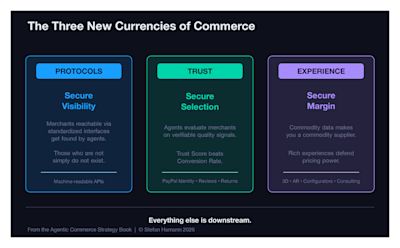
Three new currencies determine who wins:
Protocols secure visibility. Merchants who are reachable via standardized commerce protocols (UCP, AXP, AP2) get found by agents. Those who are not simply do not exist in this new channel.
Trust secures selection. Agents evaluate merchants based on verifiable quality signals: reviews, return rates, incident history, certifications. A high Trust Score beats a high conversion rate in the agent funnel.
Experience secures margin. Merchants who only provide commodity data become commodity suppliers. Those who offer rich, differentiated experiences, 3D configurators, AR viewers, expert consultations, defend their pricing power in a world where agents default to efficiency.
The age of copycat commerce ends.
Agents do not browse thousands of identical dropshipping stores. In the agent decision window, redundant supply collapses into a small number of trusted merchants.
The decision moment has moved
Historically, the critical moment in commerce was the click. Today, it is the recommendation.
If an AI agent never suggests your product, the customer never sees you. The economic center of commerce is shifting from checkout optimization to agent relevance. You could call this the next phase after SEO, except this time, the optimization target is not a search algorithm. It is an intelligent system that reasons about intent.
The current discussion is asking the wrong question. It keeps asking: "Will people pay inside ChatGPT?" But that is not the strategic question. The strategic question is: who decides which merchant gets considered? If that decision increasingly happens inside AI systems, the entire distribution layer changes. Checkout becomes a technical implementation detail. Discovery becomes the battlefield.
Checkout will become agent-driven, just not the way most people imagined
There is another reason the "Agentic Commerce is dead" narrative is premature: the checkout problem has not been solved yet, but that does not mean it disappears.
My strong conviction is that checkout will absolutely become agent-driven. The future will look something like this: every person has a trusted personal agent that understands their preferences, budgets, and constraints. That agent can perform transactions within limits defined by the user, automatic purchases below a budget threshold, approval requests for larger orders, supplier negotiations within policy rules, contract-style handshake transactions between agents.
This model delegated execution within defined trust boundaries, is economically and technically far more realistic than forcing all purchases through a chat input field. It is also exactly what AP2 (Agent Payments Protocol) and Visa's Trusted Agent Protocol are being built for. The infrastructure is being laid right now.
The stack is being built in real time
What we are witnessing is the early architecture of a fundamentally new commerce stack emerging across multiple layers simultaneously:
Discovery is moving to AI agents. Commerce orchestration is being standardized through protocols like UCP and ACP. Trust and identity are being secured through AP2, Visa TAP, and verifiable credentials. Payments are being restructured around wallet infrastructure and agent mandates. And experience is being redefined through protocols like AXP that transport not just product data, but decision logic, trust signals, and immersive content.
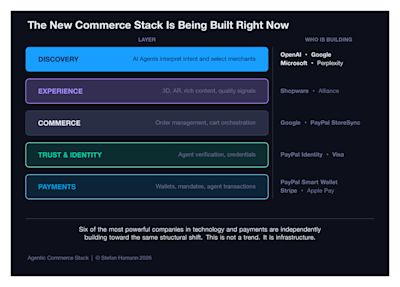
This isn´t a trend. Its infrastructure being built by the biggest players in tech.
OpenAI, Google, PayPal, Visa, Stripe, and Microsoft are all building pieces of this system. This is not a finished architecture, it is an evolving ecosystem with serious investment behind it. When six of the most powerful companies in technology and payments are independently building toward the same structural shift, dismissing it because one checkout feature was scaled back is remarkably shortsighted.
The real takeaway
OpenAI stepping back from Instant Checkout does not kill Agentic Commerce. It clarifies something much more important: the disruption is not happening at the bottom of the stack. It is happening at the top. Not at checkout. At discovery.
The future of commerce will not be decided at the payment step. It will be decided before the merchant is even seen.