
For medium-sized companies, a reliable and easy-to-use shop system is the foundation for online commerce. The choice is large and the systems differ significantly in terms of features, costs, and structure.
How do I choose the best shop system for medium-sized businesses?
When choosing a shop system for medium-sized businesses, properties that let you map your internal processes, product content, and required integrations both immediately and stably in the long term are particularly helpful. You can use the following criteria as a checklist:
Checkout and mobile optimization: Important because a large share of orders usually comes from smartphones and your shop should function quickly, clearly, and reliably even under high load.
Multiple payment methods: Relevant if you serve customers in the DACH region and want to offer familiar payment methods such as invoice, direct debit, instant payment, or wallets.
Price campaigns, discounts and promotions: If you regularly want to offer and control campaigns, sales, bundles, or vouchers without needing a developer for every action.
Personalization and customer segmentation: Useful if you want to show different prices, content, or recommendations to specific customer groups — for example, regular customers, sale buyers, or newsletter subscribers.
Content management (CMS): Important if you want to present brand worlds, guides, or campaign pages in addition to products — pages your team can maintain without technical knowledge.
Control of prices, shipping and content: Relevant if you want to automatically control conditions depending on factors such as cart value, delivery country, customer group or season — without programming each logic individually.
Automation: Helpful if you want to map recurring tasks like order confirmations, status emails, internal notifications, or integrations with other systems with as little manual effort as possible.
Interfaces and API / headless capability: Advantageous if you want to connect your shop to ERP, PIM, CRM, marketplaces or custom frontends and use the same commerce platform for multiple touchpoints.
GDPR-compliant operation with hosting options in the EU.
This article was published by Shopware as a provider of one of the mentioned solutions. It is an editorial market overview and does not claim to be complete or to represent an objective ranking. The selection of the presented shop systems is based on typical requirements of medium-sized companies such as feature set, integrability, operating models and market presence. The information on features and prices is based on publicly available information from the respective providers (status: November 2025). Changes are possible at any time. All mentioned brands are the property of their respective rights holders and are mentioned solely for information and comparison purposes.
The 5 best shop systems for medium-sized businesses
Shopware is a modular ecommerce platform from Germany, offered as a free open-source variant (Community Edition) and in three commercial plans (Rise, Evolve, Beyond). Shopware is particularly used for medium-sized online shops. B2B shops are also possible.
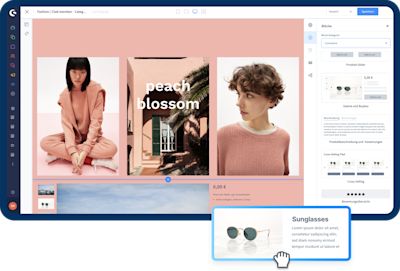
Shopping Experiences (CMS editor): For creating homepages, landing pages, category pages and brand worlds via drag & drop – without developer effort.
Control of prices, shipping, content: For automatic price and shipping logics as well as individual content depending on customer group, cart value, country or time period.
Automation of processes: For automated workflows such as order confirmations, status changes, internal notifications or integrations via webhooks.
Shopware AI: For AI-supported content creation and translation, product text optimization, review analysis and other automated assistant features.
Headless and API capability: For connecting to ERP, PIM, CRM systems, marketplaces or custom frontends such as apps and portals.
Returns, subscriptions and multi-inventory: For integrated returns management, subscription models and the management of multiple warehouse locations with separate stocks (extensive features from Beyond).
Operating models (self-hosted and cloud): For great choice in hosting – from your own servers or German/European data centers to cloud operation via Shopware’s infrastructure.
Prices for Shopware (status: November 2025, source: Shopware website):
You can get Shopware in three price tiers starting at €600 per month. The first tier, Rise, already includes Shopware AI, 3D functions and unlimited sales channels. Additional features come in the Evolve (from €2,400 per month) and Beyond (from €6,500 per month) tiers.
2) Shopify
Shopify is a cloud-based shop system originating from Canada that is used worldwide and also in German-speaking markets. The standard plans are primarily aimed at B2C and D2C retailers. For B2B use, Shopify offers a dedicated B2B feature suite within its enterprise plan Shopify Plus, which is integrated into the admin interface and allows the same shop to be used for both B2B and B2C customers.
Company accounts: Representation of business customers as companies with multiple buyers and locations, including permissions, payment terms and tax settings at account level.
Locations per company: Management of multiple company locations with their own shipping and billing addresses, tax IDs, tax exemptions, prices and payment terms.
Catalogs and price lists: Assignment of product catalogs with individual prices to companies or locations; support for price lists with fixed prices or percentage discounts.
Checkout and order processing: Customization of the checkout for B2B customers with payment terms, tax exemptions, order approval as draft orders and the ability to mark orders with purchase order numbers.
Customer area for business customers: Setup of B2B accounts with their own login area where business customers can manage their terms, orders and locations; optionally as a mixed shop for B2C and B2B or as a separate B2B store.
Quick and quantity ordering: Functions for fast ordering with larger quantities, including quick order and bulk order features in the B2B area.
Automation: Use of Shopify Flow for B2B-specific workflows, such as assigning payment terms, tagging company orders or reminders for due dates.
Integrations and app ecosystem: Connection of ERP systems like NetSuite via connectors and access to an extensive app ecosystem for additional B2B functions.
Data protection and data location: Processing of personal data based on a Data Processing Addendum (DPA); for new merchants in Europe, store, order and customer data are by default stored in European data centers, although certain processing may still involve international data transfers.
Prices for Shopify (status: November 2025, source: Shopify website):
Monthly and annual payments are offered for four plan levels. The Basic tier starts at €25 per month. In addition to package prices, card fees apply – which decrease as you choose a higher-tier plan.
3) JTL-Shop
JTL-Shop 5 is a shop software developed in Germany by JTL-Software-GmbH that works closely with the JTL-Wawi merchandise management system. The system is usually self-hosted and is geared toward use in German-language e-commerce. In addition to a free community variant, paid editions and cloud bundles are available, which cover different performance levels and support tiers.
Integration with JTL-Wawi: Control of products, prices, stocks and orders in JTL-Wawi with automatic synchronization to the online shop and other sales channels.
OnPage Composer for content and landing pages: Creation of pages via drag & drop directly in the frontend, including portlets for text, images, video and product presentations.
Template ecosystem: Provision of a responsive standard theme and access to numerous additional templates in the JTL Extension Store.
Performance optimizations: Automatic output of images in WebP format, lazy loading and responsive image sizes to improve loading times.
SEO features: Management of SEO-friendly URLs, meta titles and meta descriptions; extendable with additional SEO features via plugins.
Consent manager and GDPR support: Management of consents for plugins and tracking services as well as integrated double opt-in functions.
Extensions via the JTL Extension Store: Access to numerous plugins for payment methods, marketing, newsletter, search, tracking, product presentation and more.
Mobile-capable backend: Backend interface optimized for use on mobile devices.
Prices for JTL-Shop (status: November 2025, source: JTL website):
JTL-Shop is offered in several license tiers, starting with a free Community Edition. Paid editions start at €99 per month for the “Start” package. Features and support level increase with price.
4) OXID eShop
OXID eShop is a shop system developed in Germany by OXID eSales AG, based in Freiburg. The platform is offered in various editions, including a Community Edition, Professional Edition and an Enterprise Edition with a special Enterprise B2B edition for corporate purchasing. OXID can be self-hosted or operated as a cloud solution by service providers.
Modules: Functionality can be extended by modules or existing core functions can be modified.
Multi-shop and multi-tenant capability: Multiple subshops or tenants can be operated from a single platform – for example for different brands, regions or languages.
Headless / API-first: The system supports APIs and GraphQL interfaces, allowing frontend and backend to be decoupled and frontends such as web, app or other touchpoints to be connected.
Integrated visual CMS (content management): Content such as landing pages, banners, brand worlds or guide pages can be managed directly in the backend without separate systems and linked with product data.
Product, order and checkout functionality: Functions for product catalogs, variants, filters, search, promotions, shipping and checkout are included in the core and can be extended with add-ons.
Rights and role management: User accounts, roles, access levels or user groups (e.g., backend users, customers, partners) can be defined and controlled.
Hosting and operating models: The shop can be self-hosted or operated as a cloud platform via certified partners, covering different operational requirements.
SEO and marketing functions: SEO-friendly URLs, meta-data, modules for promotions or conversions are supported to increase visibility and marketing impact.
Prices for OXID eShop (status: November 2025, source: OXID website):
The provider works with subscription models starting at €360 per month and with minimum contract terms. The software can also be purchased outright from €4,725. When purchased, monthly fees for support and maintenance apply.
5) Spryker
Spryker is a shop system developed in Germany. The software relies on many individually combinable building blocks so that shops, marketplaces or B2B solutions can be composed to fit the business model. Spryker usually runs in the cloud and is often used when a company is growing rapidly, needs to map special processes, or wants to connect multiple digital sales channels.
Modules: The system consists of many individual modules from which shops, marketplaces or B2B solutions can be assembled to match the business model.
Headless: The backend is separate from the frontend. This allows webshop, app or other sales channels to be developed and operated independently.
Shop, B2B and marketplace: Spryker is suitable for classic online shops, business customer solutions and marketplaces where multiple vendors offer products.
Price and assortment logic: Large product catalogs, many price variants, tiered prices or time-controlled prices can be managed.
Management of content and media: Images, banners and other media can be centrally organized and used across channels.
Cloud operation: The platform is usually operated as a cloud solution so that infrastructure, updates and scaling are automatically managed.
Prices for Spryker (status: November 2025, source: Spryker website):
Spryker does not publish prices on its website.
Is Shopware the right shop system for your medium-sized company?
If Shopware convinced you, you can book your personal demo directly here. There you will get a look into the system and learn how to best use Shopware for your project.
The best shop systems for medium-sized businesses – frequently asked questions and answers
What should I look for when choosing a shop system?
Important factors are usability, integrations, loading times, checkout quality, SEO features, automation and GDPR compliance.
What is the difference between cloud-based and self-hosted shop systems?
Cloud systems take care of hosting, maintenance and updates, but offer less technical control. Self-hosted systems give you full freedom over location, servers and customization, but require more technical know-how or agency support.
Can I switch from one shop system to another later?
Yes – a switch is possible, but the effort depends heavily on your existing data, integrations and shop architecture. The more complex your processes, the more carefully a relaunch must be planned.
What role does the GDPR play when choosing a shop system?
The system should offer functions for data protection, cookie consents, deletion concepts and data subject rights. It is also important to know where your data is stored – ideally in the EU or in data centers with GDPR-compliant agreements.
Can I connect a shop system to both online shop and brick-and-mortar retail?
Yes – many systems today offer POS integrations or interfaces to cash register systems. This allows you to manage stock levels, sales and customer data across channels.