



In B2B online stores, your customers receive different pricing, multiple users within one company place orders, and individual terms and conditions apply. The best B2B ecommerce platforms support these and many other functions – and integrate seamlessly with ERP, PIM, or CRM systems.
(“Best” here refers to widely used and well-established solutions in the market with comprehensive B2B functionality. The selection is based on market presence and publicly available information.)
How do I choose the best B2B ecommerce platform?
When selecting the best B2B ecommerce platform, the key factor is whether the chosen solution can reliably map all processes, pricing logic, and customer structures within your company.
Company accounts and role management: Relevant if multiple individuals per customer company place orders, approve purchases, or manage accounts – requiring different permission levels.
Pricing and conditions: Essential if you need individual price lists, discounts, tiered pricing, or payment terms per customer.
Customer-specific assortments and visibility: Beneficial if certain products or categories should only be visible to selected customers or regions.
Quotes and approvals: Important if orders are handled through quote requests, budgets, or internal approval workflows.
Quick ordering and recurring order lists: Helpful if orders are placed regularly using item numbers, CSV uploads, or saved purchasing lists.
Automation: Relevant if notifications, status changes, internal tasks, or integration processes should function without manual effort.
Rules for pricing, payment methods, and shipping: Useful if conditions need to be controlled based on factors such as customer group, cart value, or delivery country.
User-friendly CMS: Valuable if content such as landing pages, use cases, or brand experiences are important alongside the ordering process.
API and headless capabilities: Necessary if integrations with ERP, PIM, or CRM systems – as well as custom frontends, portals, or apps – are required.
The following information regarding features, pricing, and services is based on publicly available sources from the respective providers (as of November 2025). It is provided for guidance purposes only. Providers may change their offerings at any time; no guarantee is given for accuracy or completeness.
This article includes a presentation of Shopware as part of a market overview. It is based on careful research but is not an objective test report. Instead, it is an editorial comparison that includes promotional elements in part.
All mentioned brands are the property of their respective owners and are listed for comparison purposes only. Shopware has no business relationship with the providers mentioned.
6 popular B2B ecommerce platforms for your business
Shopware is an ecommerce platform developed in Germany that is widely used for B2B online stores. B2C stores are also possible. Shopware can be used as a traditional online store but is equally suitable for building custom customer interfaces such as customer portals, apps, or highly complex sales processes. Companies can choose between a free open-source version and extended commercial plans.
Company accounts and role management for business customers
Customer-specific pricing, terms, and assortments
Quote management for handling quote requests and processing
Approval and budget management for internal authorization workflows
Quick order functionality via SKU entry or file import
Order lists for recurring purchases
Rule-based control of pricing, shipping methods, and payment methods
Automation of workflows such as notifications or status changes
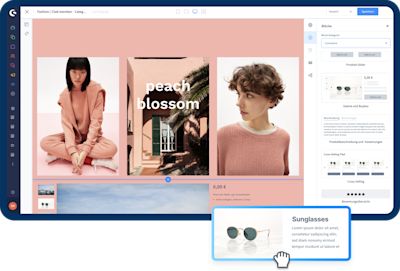
Integrated CMS for creating content, landing pages, and product experiences
System integrations via APIs, for example with ERP, CRM, or PIM
Multi-inventory management (available in higher-tier plans)
Subscription models for recurring purchases (available in higher-tier plans)
GDPR-compliant operation with hosting options within the EU
Shopware pricing (as of November 2025)
Shopware is available in three pricing tiers starting at €600 per month. The first tier, Shopware Rise, already includes Shopware AI, 3D features, and unlimited sales channels. Additional features are included in Shopware Evolve (starting at €2,400 per month) and Shopware Beyond (starting at €6,500 per month).
2) Spryker
Spryker is an enterprise ecommerce platform designed for sometimes highly complex B2B and B2C marketplaces. The software is built on a modular structure and an API-oriented architecture and is typically operated as a cloud platform. Companies primarily use Spryker when multiple brands, countries, or sales channels with their own processes and frontends need to be managed within one system.
Company accounts: Customer accounts in which administrators can create, edit, and structure business units.
Roles and permissions: Assignment of permissions for users within a company (for example, buyer, approver, administrator), including access rights to view orders at the business unit level or for the entire company.
Business on behalf: Users can act on behalf of different business units and, for example, place orders for various locations or departments.
B2B shopping lists and carts: Management of multiple shopping lists, shared carts, and quick ordering via product numbers.
Approval workflows: Configurable approval processes for carts, where orders above certain thresholds or conditions must be approved by authorized individuals.
Quote and contract management: Features for creating and negotiating quotes (quote management) as well as B2B contract functionalities.
Product and access restrictions: Ability to make products or information accessible only to specific companies, business units, or users.
Cloud operation with PaaS model: Spryker Cloud Commerce OS is offered as a platform-as-a-service with a high degree of flexibility for development; with PaaS+, Spryker takes over infrastructure and scaling management.
Security, certifications, and GDPR compliance: Operation in data centers across Europe, the United States, and APAC, an ISO/IEC 27001:2022-certified information security management system, SOC 2 reports, as well as documentation and guidelines for GDPR compliance.
Spryker pricing (as of November 2025):
Spryker does not publish pricing information on its website.
3) SAP Commerce Cloud
SAP Commerce Cloud is SAP’s ecommerce platform for B2B, B2C, and B2B2C. It is part of the SAP Customer Experience suite and is operated as a cloud solution. The platform combines product catalogs, pricing logic, order processes, and self-service functions and integrates closely with other SAP systems such as SAP ERP or SAP S/4HANA.
B2B account structures: Company accounts with organizational structures, cost centers, spending limits, and roles for different users within a company.
Roles and permission concepts: Assignment of rights for buyers, administrators, and approvers, including access to order history and documents at the account or business unit level.
Approval workflows: Configurable internal approval processes for orders, for example based on order value, cost center, or user role.
Contract and special pricing: Support for contract pricing, customer-specific price lists, discount structures, and B2B terms.
Quote and negotiation functions: Creation of quotes, customer quote requests, and negotiation processes between sales teams and customers.
Self-service portal for B2B customers: Self-service capabilities for account management, order history, reordering, and documents such as invoices or delivery notes.
Product catalog and variant management: Management of catalogs including variants, configurations, and technical specifications.
Search, personalization, and promotions: Search and filter functions, personalized content, as well as promotions and discounts based on customer data and rules.
Integration with SAP systems: Integration with SAP ERP, SAP S/4HANA, and other SAP CX solutions via predefined interfaces.
Cloud operation and compliance: Operation in SAP data center regions worldwide, including Europe, with certifications such as ISO/IEC 27001 and alignment with GDPR requirements.
SAP Commerce Cloud pricing (as of November 2025):
SAP does not publish pricing for SAP Commerce Cloud on its website. The software is licensed as a cloud-based subscription.
4) OXID eShop
OXID eShop is an ecommerce software developed in Germany by OXID eSales AG, headquartered in Freiburg. The platform is offered in several editions, including a Community Edition, Professional Edition, and an Enterprise Edition with a dedicated Enterprise B2B Edition for corporate purchasing. OXID can be self-hosted or operated as a cloud solution through service providers and is frequently used in the German-speaking market for B2B and combined B2B/B2C scenarios.
Enterprise B2B Edition with additional B2B modules: Eleven B2B modules extend the Enterprise Edition with features such as self-administration, approval workflows, budget management, quick, bulk, and scheduled orders, service-based products in the cart, as well as customer-specific pricing and quotes.
Company accounts and self-administration: Business customers, partners, and suppliers can manage accounts, users, and settings within their own dedicated area.
Approval and budget management: Mapping of individual purchasing processes, organizational structures, and cost control in corporate procurement, including approval and budget mechanisms.
Quick, bulk, and scheduled orders: Support for quick orders, bulk orders, and scheduled orders as part of the B2B modules.
Customer-specific pricing and quotes: Ability to store customer-specific prices and quotes within the system and provide them via the B2B modules.
Catalog and assortment management: Management of complete catalogs and assortments, including multi-client capability and multi-language support in the Enterprise Edition.
Multi-shop and multi-client operation: Support for multiple shops and clients within a single instance, particularly in the Enterprise Edition.
Integration with enterprise systems: Integration of ERP, CRM, and PIM systems via interfaces and partner solutions, for example integration with Microsoft Dynamics.
GDPR compliance: GDPR Opt-in module for managing consent to store and process personal data, as well as various cookie consent solutions for GDPR-compliant cookie integration.
Operating models and hosting: Operation as a self-hosted solution on proprietary infrastructure or via specialized service providers with data stored on servers located in Germany.
OXID eShop pricing (as of November 2025):
The provider offers subscription models starting at €360 per month with minimum contract terms. The software can also be purchased starting at €4,725. In the case of purchase, additional monthly fees apply for support and maintenance.
5) commercetools
commercetools is a commerce platform headquartered in Europe that operates entirely as a cloud service and specializes in API-based architectures. The solution is used by international companies for B2B, B2C, and omnichannel scenarios and enables the creation of customized ecommerce systems based on modular components.
Structures with business units: Representation of companies and business divisions as business units with hierarchical structures and inheritable settings.
Roles and permissions: Assignment of roles and permissions for individual users within a business unit, including granular access rights to resources.
Catalogs, pricing, and discounts: Support for customer- or company-specific product catalogs, pricing, tiered pricing, and discounts across business units, stores, and pricing/discount functions.
Quotes and approvals: Quotes API for quote creation and management, as well as configuration of approval rules for multi-step B2B purchasing processes.
Orders and payments: Order processes, shared carts, and various payment methods, including invoice payments or purchase orders.
Multi-language and internationalization: Management of countries, languages, currencies, tax rules, shipping methods, and sales channels at the project level.
API and integrations: HTTP API with SDKs for various programming languages to connect frontends as well as ERP, PIM, and CRM systems.
Cloud operation: Operated as SaaS in certified data centers across multiple locations in Europe, the United States, and APAC.
Security and compliance: Alignment with standards such as ISO/IEC 27001, TISAX, and GDPR, as well as documentation supporting the implementation of data protection requirements.
commercetools pricing (as of November 2025):
Pricing is not publicly disclosed but is offered based on feature scope, usage volume, and individual configuration. The website describes a user- and volume-based subscription model.
6) Shopify
Shopify is a cloud-based ecommerce platform originating in Canada that is used worldwide, including in the German-speaking market. Its standard plans are primarily designed for B2C and D2C merchants. For B2B use cases, Shopify offers a dedicated B2B feature suite as part of its enterprise plan, Shopify Plus. These B2B features are integrated into the admin interface and allow the same store to serve both B2B and B2C customers.
Company accounts: Representation of business customers as companies with multiple buyers and locations, including permissions, payment terms, and tax settings at the account level.
Locations per company: Management of multiple company locations with their own shipping and billing addresses, tax IDs, tax exemptions, pricing, and payment terms.
Catalogs and price lists: Assignment of product catalogs with individual pricing to companies or locations; support for price lists with fixed prices or percentage-based discounts.
Checkout and order processing: Customization of checkout for B2B customers with payment terms, tax exemptions, draft order approval workflows (“Draft Orders”), and the option to attach purchase order numbers to orders.
Customer portal for business customers: Setup of B2B accounts with a dedicated login area where business customers can manage their terms, orders, and locations; available either within a combined B2C/B2B store or as a separate B2B store.
Quick and bulk ordering: Features supporting fast ordering of larger quantities, including quick order and bulk order functions in the B2B area.
Automation: Use of Shopify Flow for B2B-specific workflows, such as assigning payment terms, tagging company orders, or sending due date reminders.
Integrations and app ecosystem: Integration with ERP systems such as NetSuite via connectors, as well as access to an extensive app ecosystem for additional B2B functionalities.
Data protection and data location: Processing of personal data based on a Data Processing Addendum (DPA); for new merchants in Europe, store, order, and customer data are stored by default in European data centers, while certain processing activities may still involve international data transfers.
Shopify pricing (as of November 2025):
Four pricing tiers are offered with monthly and annual payment options. The Basic plan starts at €25 per month. In addition to the subscription fees, card processing fees apply, which decrease as the plan tier increases.
Shopware offers company accounts, customer-specific terms, and B2B-optimized ordering processes. Typical purchasing structures – such as buyers, department managers, or accounting teams – can already be mapped within the standard scope of the corresponding plans.
Shopware is developed in Germany and hosts in Europe. With EU hosting options and the necessary technical foundations, Shopware supports you in implementing data protection–compliant structures. However, actual GDPR compliance always depends on your individual implementation and usage.
Do you have questions?
Discuss your business goals and individual requirements in a personal consultation.
Product demo
Experience Shopware features in action and discover how we can help you and your business move forward.
Popular B2B ecommerce platforms – frequently asked questions and answers
Do you absolutely need an ERP system to run a B2B store?
Not necessarily. For small product ranges or simple processes, operating without an ERP system is possible. However, for larger companies, integration is recommended to ensure that inventory, pricing, and customer data remain synchronized.
Which hosting models are suitable for B2B?
Many platforms offer cloud, platform-based, or self-hosted options. B2B companies often choose models that take data protection, data location, and integration capabilities into account.
How important is automation in a B2B store?
Very important, as many processes are recurring – such as notifications, approvals, status changes, or updates to ERP systems. Automation features help reduce manual effort.
Can a B2B store also serve B2C customers at the same time?
Yes, many platforms allow both models to be combined within a single installation, for example through different customer groups, pricing rules, or frontend configurations.