



Multichannel ecommerce refers to the parallel distribution of goods via several separate sales channels. In addition to your own online store, you use additional platforms such as online marketplaces (Amazon, eBay), social media channels (TikTok Shop, Instagram), or brick-and-mortar retail stores.
Multichannel ecommerce: The most important facts in brief
Multichannel refers to parallel distribution via separate channels (own shop, marketplaces such as Amazon/eBay, social media). The channels usually operate independently of each other.
Inventory reconciliation: Automated synchronization of inventory across all channels is essential to prevent overselling and resulting marketplace suspensions.
Data storage: All product data should be maintained in one place (single point of truth) and prepared via interfaces for the requirements of the respective channels (image formats, categories).
Risk management: Having a presence on multiple platforms reduces your dependence on individual traffic sources or algorithm changes on a single platform.
Order processing: All orders must converge in a uniform workflow so that logistics and customer service can work effectively and without system breaks.
What are the most common channels in multichannel ecommerce?
When planning your multichannel strategy, there are several options available to you:
Your own online store: Your digital home, where you have full control over the design and customer data.
Online marketplaces: Platforms such as Amazon or eBay offer you instant access to millions of customers, but they charge fees and subject you to their rules.
Social commerce: Direct sales via apps such as TikTok or Instagram, where the impulse to buy arises directly from the content.
Price comparison portals: Google Shopping or Idealo serve as reach boosters that drive traffic to your store.
The key distinction lies in the level of integration. Multichannel ecommerce focuses on operating across as many channels as possible in parallel – a question of reach and volume. Omnichannel, by contrast, is designed to deliver a connected, consistent shopping experience across all touchpoints – a question of quality and coherence.
In a multichannel model, a customer completes a purchase within a single channel, whether that’s an online store or a marketplace like Amazon. In an omnichannel model, journeys can span channels seamlessly: customers might order online and pick up in-store (click & collect), or purchase in-store via a tablet and have the product shipped to their home.
What are the advantages of multichannel ecommerce?
The core advantage of multichannel ecommerce lies in active risk diversification and access to closed marketplace ecosystems. In your own online store, you have full control, but you have to work hard to acquire every visitor.
Additional channels allow you to leverage the existing trust and sometimes enormous reach of platforms such as Amazon or eBay. You increase your sales and visibility and protect your entire business from dependence on individual traffic sources.
Immediate access to existing customer flows: On marketplaces, you don't have to "generate" traffic, you just have to "capture" it. Millions of people start their product search directly on Amazon and other platforms. With a multichannel presence, you place your product range in this already flowing stream instead of waiting for customers to find your store via search engines.
Reducing platform dependency: If your entire revenue depends on a single channel (e.g., Google Ads), you are extremely vulnerable. Changes to the algorithm or rising click prices can jeopardize your business model overnight. Multichannel distributes this burden: if one channel weakens, the others can compensate for the slump.
Leveraging impulse purchases via social commerce: Multichannel also means selling where attention is generated. Social media channels such as TikTok or Instagram display your product in feeds and at moments of high attention. It can be purchased directly there without having to go through an external search.
Quick test of new markets and product ranges: Multichannel is your laboratory. Want to know whether your product will be a hit in France or Italy? Instead of setting up a localized online store right away, you can test your goods via international marketplaces. Customer feedback and sales figures provide you with a reliable data basis before you make any major investments.
What challenges do I face with multichannel distribution?
The biggest hurdle in multichannel sales is the rapidly increasing complexity of managing inventory and product data. With each additional channel, the risk of overselling increases if inventory is not synchronized in real time.
In addition, marketplaces such as Amazon or TikTok require specific data formats and quality standards, which makes manual maintenance of your items almost impossible. Without automated consolidation of all incoming orders, you will quickly lose track of your logistics and customer service.
Overselling in multichannel ecommerce
If you offer a product in your own shop and on eBay at the same time, you have a problem as soon as there is only one item left in stock. If this item sells on both platforms at almost the same time, you have to cancel one of the orders.
This leads to disappointed customers and quickly results in poor rankings or even account suspensions on marketplaces. Once a certain order volume is reached, manual correction of inventory is no longer feasible without errors.
Different requirements for product data in multichannel ecommerce
You can't simply copy and paste your product data to all channels, because each marketplace has its own rules:
Amazon requires specific categorizations and white background images.
TikTok Shop focuses on short, concise titles and vertical video formats.
Google Shopping requires exact GTINs and structured data.
Managing these content requirements without maintaining a separate database for each platform is one of the biggest administrative tasks in everyday multichannel operations.
Logistical complexity and order handling in multichannel ecommerce
When orders come in from different sources, your team needs to know which package goes where and what shipping conditions apply.
Then there is returns management: a return from a marketplace must be handled differently in terms of accounting and logistics than a direct return to your store.
Legal and tax hurdles in multichannel ecommerce
If you sell across national borders or use fulfillment programs such as "Fulfillment by Amazon" (FBA), the tax situation becomes complex. Different VAT rates and delivery thresholds must be recorded correctly.
In addition, each marketplace has its own legal requirements for the imprint, the cancellation policy, and the terms and conditions, which you must keep up to date.
How can I master the complexity of multichannel ecommerce?
For sustainable multichannel operation of your ecommerce, you should consistently centralize your data streams. Instead of managing each channel (shop, Amazon, eBay, etc.) individually, you use a central control unit, usually your shop system or a connected ERP system, to automatically distribute inventory, prices, and product data to all platforms.
Incoming orders from all sources flow back to this central point in reverse, allowing you to handle the entire process from listing to shipping in one place.
Central product data management (single point of truth)
Instead of uploading product descriptions and images separately for each channel, you only need to maintain your master data once in your main system. This information is then distributed to the respective channels via interfaces.
This saves you a lot of time and ensures that your brand message and product details are consistent everywhere.
Automated inventory reconciliation in real time
The most important technical requirement is automated inventory management. As soon as a sale takes place on one channel, the central system must register this deduction and immediately report the new inventory level to all other connected channels.
This real-time synchronization is the only effective measure against overselling and the associated sanctions imposed by marketplaces.
Order aggregation: All orders in one workflow
A powerful multichannel setup bundles all orders in a shared overview. For your team in the warehouse or shipping department, it then makes no difference whether an order comes from your own web shop or from an external marketplace.
The pick and pack process remains identical, and shipping confirmations and tracking numbers are also automatically returned to the respective source channel by the central system.
Achieve multichannel success with Shopware
Instead of managing each marketplace or social network individually, Shopware allows you to manage all channels from a single interface. Thanks to its API-first architecture, the system is also designed to exchange data with marketplaces, ERP systems, and feed management tools, giving you full control over your inventory and prices, no matter where you sell.
In Shopware, the "multichannel" principle is the basis of the software. You can create as many sales channels as you like in the admin area, whether for different country shops, for Instagram Shopping, or for large marketplaces.
Centralized management: You enter your products once and decide with a click of the mouse in which channels they should be visible.
Individual control: You can define your own prices, currencies, or product ranges for each channel. For example, you can sell on Amazon under different conditions than in your own shop.
Since Shopware was developed according to the API-first principle, every function of the shop can be accessed via a programming interface:
Easy connection: Marketplace providers can exchange data with your shop in real time with exceptional stability.
Future-proof: As soon as you want to open a new sales channel, the technical hurdle for connection is minimal, as Shopware already speaks the language of third-party systems and you can display your products there.
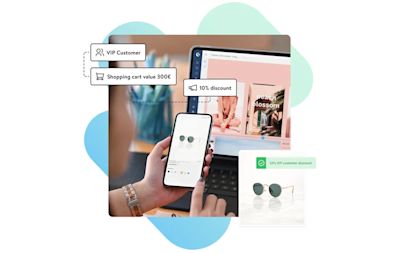
With the Rule Builder, you can specify that certain shipping methods are only available for orders from your webshop or that customers on a specific marketplace do not pay shipping costs above a certain order value. These and many other rules can be set directly in the administration without any programming.
Get to know Shopware!
Digitize your wholesale business and expand your sales channel to your customers. Offer them features they feel comfortable with and won't want to do without. Get started with Shopware now!
Multichannel ecommerce – frequently asked questions
What’s the difference between multichannel and omnichannel?
In a multichannel model, you operate across several channels in parallel, but from the customer’s perspective, these channels remain largely disconnected. A customer completes their purchase either on channel A or channel B. Omnichannel, by contrast, integrates these channels deeply, enabling cross-channel experiences such as returning an online purchase in a physical store.
Which channels should I start with?
This depends on your target audience. For most merchants, the combination of a proprietary online store and a high-reach marketplace such as Amazon or eBay is a practical starting point. If you sell visually driven products, social commerce platforms like Instagram can provide a strong complementary channel.
Do I need an ERP system for multichannel ecommerce?
Beyond a certain order volume, automated operations become essential. An ERP system, combined with a robust ecommerce platform such as Shopware, ensures efficient coordination. Manual inventory management inevitably leads to errors and overselling as volume increases.
How should I handle different pricing across channels?
From a technical and strategic standpoint, managing prices by channel is advisable. This allows you to factor in marketplace fees directly, while offering more competitive pricing in your own online store. In Shopware, you can define channel-specific pricing logic for each marketplace.
Does multichannel increase logistical complexity?
Without software support, it does. With an integrated system, however, all orders are consolidated into a single view. Your fulfillment process remains consistent, regardless of the channel through which the order was placed.