

The ecommerce market is at a turning point: complexity is increasing, demands are rising – and platform decisions are becoming more strategic than ever. So what does it mean that Shopware ranked number one in the open source category in the Emerce 100 2026?
More than a ranking: a signal to the market
The Emerce 100 is one of the most recognized rankings in the digital economy in the Netherlands. Each year, industry decision-makers evaluate leading ecommerce providers based on criteria such as expertise, price-performance ratio, service quality, and reliability.
In 2026, Shopware achieved:
#1 in open source ecommerce software
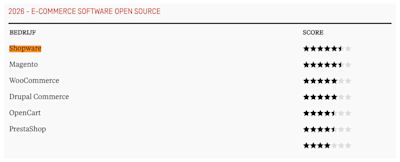
Shopware defends its leading position and improves by 0.5 points compared to last year.
#2 in commercial ecommerce software
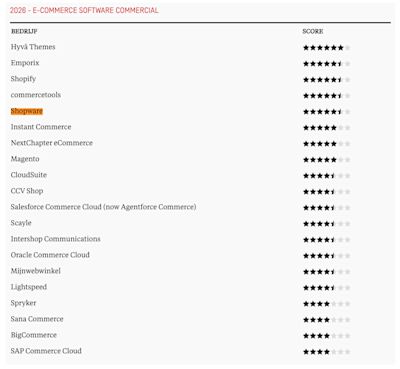
Shopware achieved the same number of rating points as last year and ranks second.
Source: Emerce
These rankings are more than a snapshot in time. They reflect a clear market shift: companies are increasingly choosing technologies that provide long-term control, flexibility, and independence.
Why these rankings matter more than ever
The reality of ecommerce has changed. Many companies are now facing challenges such as:
Running B2C and B2B business models in parallel
Expanding internationally across multiple markets
Integrating complex system landscapes (ERP, PIM, CRM)
Increasing requirements around data protection and compliance
A typical example: A manufacturer combines D2C sales with international B2B structures – including custom pricing logic, customer-specific catalogs, and country-specific requirements. This is exactly where traditional systems start to reach their limits.
That’s why rankings like the Emerce 100 provide real guidance: they highlight which platforms perform under real-world conditions.
Open source as a strategic choice
Being recognized as a leading open source platform stands for more than just technology – it represents a clear principle: independence.
Unlike closed SaaS systems, an open source approach enables:
No vendor lock-ins
Full transparency in the code
Unlimited customization
Flexible deployment models (cloud or on-premises)
This is exactly where Shopware stands out: With an open, API-first architecture that adapts to your business model – not the other way around. For growing businesses, this becomes a decisive advantage.
Data Sovereignty as a competitive advantage
Data has long become a strategic asset. It determines how effectively you can:
personalize customer experiences
make data-driven decisions
develop new business models
Closed platforms often limit these capabilities.
Shopware takes a different approach: You retain full control over where your data is stored, how it is processed, and how it integrates into your system landscape. This means maximum flexibility, full compliance confidence, and long-term future readiness for your business.
Complex commerce requires the right architecture
The second ranking – #2 in commercial ecommerce software – shows that these principles are also gaining traction in the enterprise space.
Modern ecommerce setups are inherently complex:
Multi-brand strategies with multiple storefronts
International rollouts with local requirements
B2B processes with custom approvals and pricing structures
Seamless integration of content, commerce, and data
Monolithic platforms quickly reach their limits in these scenarios.
Shopware is built specifically to handle these challenges:
API-first architecture
modular extensibility
seamless integration into existing systems
This is what makes the difference in complex projects – and explains the strong ranking in both categories.
What this means for your platform decision
If you’re currently evaluating a new ecommerce platform, it’s no longer just about features.The key questions are: How flexible is your platform as complexity grows? How well does it integrate with your existing system landscape? And how much control do you have over your data and processes?
The Emerce 100 makes one thing clear: Companies that choose open and flexible technologies gain long-term competitive advantages.
Looking ahead: the future is open and connected
Ecommerce continues to evolve – becoming faster, more complex, and increasingly interconnected. Customers expect personalized experiences, seamless customer journeys, and consistent interactions across all touchpoints.
To deliver on these expectations, platforms need to continuously adapt. Open and flexible architectures provide the foundation for this.
Conclusion: the key question for your future
The Emerce 100 2026 makes it clear that successful ecommerce strategies are built on openness, flexibility, and control. Shopware’s recognition reinforces exactly this approach.
The key question is no longer whether your setup will become more complex – but whether your platform is ready for it.
Find out if your current platform still supports your growth.
You might also be interested in