

With Shopware 6.7.13.0, you can convert guest accounts into registered customer accounts, gain more control over variant display in Dynamic Product Groups, and benefit from new capabilities for B2B Components. In addition, this release brings improvements to category management, storefront SEO, and overall performance.
You’ll find all the details in the sections below.
Overview:

More control over variant display in Dynamic Product Groups
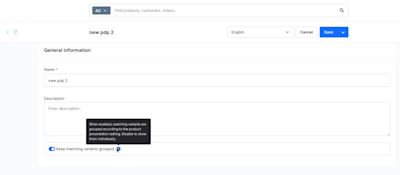
Dynamic Product Groups now include a new "Keep matching variants grouped" option. When disabled, matching product variants are displayed individually instead of being grouped under a single parent product.
This gives you more flexibility when presenting products in category listings, cross-selling sections, and CMS product sliders, allowing you to decide whether customers should see individual variants or grouped products.
You can find detailed information in our documentation.
Convert guest accounts into registered customer accounts
Guest checkout boosts conversion but often results in fragmented customer data and missed opportunities for repeat engagement. Guest accounts can now be converted into full customer accounts, either by the customer or by you in the Administration. Complete order history and contact information are retained.
For customers in the storefront
Right after completing an order, guest customers can set a password themselves and turn their guest account into a regular customer account. The order they just placed stays linked to the account and there is no need to re-enter any data.
For you in the administration
The “General” section of the customer detail view now offers a new action, "Convert to registered account". You have two options for the password:
Send a secure password reset link by email (recommended)
Set a password manually without notifying the customer
For more information, take a look at our documentation.
Faster category management
Managing categories is now significantly more efficient, especially for shops with large category trees. When you create or edit a category, Shopware now updates only the affected category and its subcategories instead of reprocessing unrelated parts of the category structure.
This reduces unnecessary background processing, speeds up save operations, and improves overall performance when managing large product catalogs.
Better storefront SEO
This release includes several improvements to storefront SEO:
Canonical URLs now correctly distinguish paginated category pages, helping search engines index them more accurately.
In addition, Link Categories now receive SEO URLs again and redirect visitors directly to their configured destination instead of returning a 404 page.
The default robots.txt has also been updated to better support product feed URLs used by Google Merchant Center.

With Shopware 6.7.13.0, several technical improvements have been implemented across the platform. Highlights include:
Improved platform performance through stateless Store API requests, optimized category management, and more resilient media processing.
Enhanced Elasticsearch support with better phrase matching and more flexible ranking configuration.
Declarative custom field configuration for apps and plugins, simplifying extension development.
New Admin API endpoints for translation management and media downloads.
Additional improvements across the Administration, APIs, developer experience, and platform performance.
For a complete overview, check the changelog.

This section is about features that are not included in the Community Edition. Take a look at our overview to compare the different Shopware plans and activate the Shopware Commercial extension to use the commercial features.
Handle complex quotes, changes and status' in one place
As voted on UserVoice!
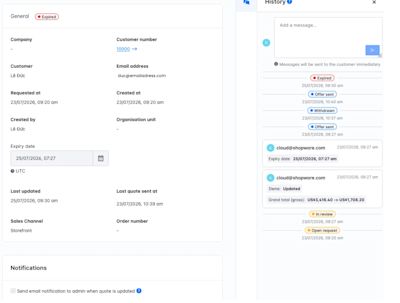
Quote Management now supports extended capabilities, equipping you with the tools to negotiate complex quotes with confidence, speed and precision. New capabilities include:
Product-level comments
Full quote and message history
Document version tracking
Product-level discounts
Shipping cost visibility
Updated quote statuses with optional notifications.
Build customer trust with more visibility into total costs and quote history, all in one place.
Learn more about B2B Components
Check out the documentation
Manage complex B2B structures from one place
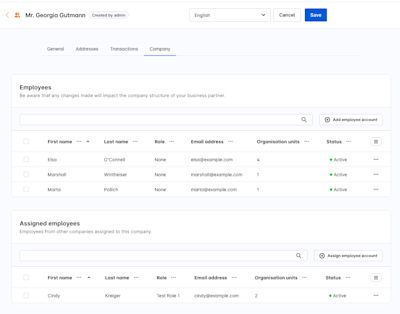
B2B Components now supports multi-context employee accounts, giving you the tools to set up and scale even the most complex B2B organisations without custom development.
New capabilities include:
Multi-context employee accounts across several Organization Units and companies
Context switching at login or from the account area, without logging out or separate credentials
Sub Organization Units beneath existing Organization Units for more granular hierarchies
Budget configuration per Sub Organization Unit, with optional access to the parent unit's budget
Reduce repetitive setup for merchants and partners, and let employees work in the right context out of the box.
Learn more about B2B Components
Check out the documentation

We wish you lots of fun and success with the latest version of Shopware.

We extend our heartfelt thanks to all GitHub contributors for their pull requests that have been incorporated into this version. 💙