Contact us
 Download logo as SVGDownload logo as PNG
 Copy logo as SVG
 Visit brand guidelines




Good360 Australia migrated from a heavily customized Magento platform to Shopware Beyond to better support its nonprofit mission and complex distribution model. By replacing custom code with Shopware’s native low-code capabilities, the organization simplified donor restrictions, improved internal efficiency, and created a scalable, self-hosted platform designed for long-term growth.
Good360 Australia connects charities, schools, and community organizations with businesses and government partners willing to donate surplus goods and essential supplies. To deliver on that mission at scale, Good360 operates as a technology, logistics, and people organization, using ecommerce to redistribute donated and wholesale products across Australia.
Unlike traditional retailers, Good360’s commerce model is built around trust and compliance. Donated goods often come with strict redistribution requirements, including geographic limits, eligibility criteria, or cause-based restrictions. Donors need confidence that their products reach the intended recipients, while nonprofit customers need a familiar and straightforward shopping experience that does not add administrative burden.
To balance these needs, Good360 intentionally uses a B2C-style ecommerce experience to serve a B2B audience. Donated and wholesale products are presented in a single storefront, while complex rules and validations operate behind the scenes to ensure every transaction complies with donor and regulatory requirements.
Good360 ran its ecommerce operations on Magento and later Magento 2 for roughly six years. Early on, the platform’s flexibility enabled the team to build custom logic to support its non-standard business model.
As the organization grew, however, that approach became increasingly difficult to maintain. Core workflows relied on hard-coded customizations, making even small changes time-consuming and costly. Managing product eligibility, checkout behavior, and shipping logic required ongoing development effort.
At the same time, Adobe’s shift toward Adobe Commerce introduced additional uncertainty. As a nonprofit organization, Good360 needed a platform that was not only flexible, but also affordable and sustainable over the long term. Rather than continuing to layer custom code onto an already complex system, the team began looking for a platform that could support its rules-driven model natively.
When evaluating alternatives, Good360 focused on two primary priorities: flexibility and affordability. The team considered several platforms, including Adobe Commerce, Shopify, and Shopware.
Many mainstream ecommerce platforms handled standard B2C use cases well but struggled with Good360’s non-standard requirements. Donated products often include redistribution rules tied to location, funding sources, or social causes, and enforcing those rules dynamically is essential to maintaining donor trust.
Over time, the effort required to maintain custom-built logic became a key factor in the decision. “We spent a lot of time and effort customizing Magento to fit our slightly non-standard business model,” the Good360 team shared. “We saw that Shopware had many of the core features we had to build ourselves before. It was an obvious fit for our next catalog.”
Through its long-standing relationship with ITG Commerce, now Bluprintx, Good360 was introduced to Shopware and explored the platform in depth during a Shopware system administration conference. What stood out was that Shopware’s native approach to rule management and workflow automation closely aligned with Good360's operations.
Instead of relying on custom development, the platform enabled management of complex business logic directly within the administration interface. With confidence in both the platform’s capabilities and its long-term viability, Good360 selected Shopware Beyond as the foundation for its next phase of digital commerce.
One of Good360’s primary goals in moving to Shopware was to reduce its reliance on custom code. On Magento, many core workflows had been built from scratch, increasing complexity and long-term maintenance effort.
With Shopware, those workflows could be modeled directly within the platform. Using Rule Builder and Flow Builder, Good360 configured:
Product eligibility based on donor, location, and cause
Dynamic product visibility, so users only see the items they qualify for
Complex checkout logic, including mixed carts with multiple donors
Multiple shipping options, including donated and subsidized shipping
By enforcing rules earlier in the shopping journey, Shopware reduced error messaging and created a smoother experience for nonprofit customers. At the same time, internal teams could quickly adapt rules as donor requirements changed, without waiting for development cycles.
“Things that used to take weeks can now be done in minutes using rule and flow builders,” said Shawn Peters, CTO of Good360.
Good360 took a deliberate, lean approach to migration. Rather than replicating its Magento setup, the team focused on replacing custom logic with native Shopware functionality.
The project spanned roughly ten months from discovery and planning, with six months of active development. Good360 worked with Bluprintx, a long-standing partner that understood both the organization’s technical environment and nonprofit constraints, as well as the importance of responsive, hands-on support.
“We started with ITG Commerce before they became Bluprintx. I’ve worked with them for almost twelve years,” explained Shawn Peters. “Exceptional service. I can call them anytime, and they pick up.”
The resulting platform was designed for stability, integration, and internal ownership. It includes a self-hosted deployment on AWS, an API-first and double-headless Shopware 6 architecture, and Workato as the central integration layer connecting NetSuite and Salesforce. Inventory and fulfillment are managed in NetSuite, with daily synchronization to Shopware, while a modular extension approach allows functionality to be added or updated without increasing system risk.
This architecture gives Good360 greater control over day-to-day operations and the flexibility to integrate new systems as the organization evolves.
As the launch approached, the Good360 team was mindful of its audience. Many nonprofit customers are not highly technical, and any disruption to the ordering process could slow the distribution of essential goods.
In practice, the transition to Shopware proved smoother than expected. The new platform introduced minimal friction for customers, and internal teams supported the rollout with few issues. Most post-launch work focused on minor refinements rather than structural changes.
The result was a stable go-live that allowed Good360 to continue serving its network of charities and schools without interruption, while giving the internal team confidence in the new platform.
Since moving to Shopware Beyond, Good360 has changed how it operates day-to-day. Tasks that previously required development support can now be handled internally, often in minutes rather than weeks. This has reduced technical bottlenecks and made it easier to respond quickly to donor requirements and changing community needs.
Looking ahead, Good360 plans to expand activity tracking, digitize donor intake, and evolve toward a two-sided marketplace that better connects donors and nonprofit partners. Additional sales channels, including social commerce, are also part of the roadmap.
With a flexible, self-hosted platform in place, Good360 can focus less on maintaining custom infrastructure and more on delivering impact at scale.
Discover the power of innovative Shopware features - the core of our unique solution. Experience which of these features our customer has successfully used in their own case. Dive deeper into the details and use this inspiration for your own project.
No limits. Guaranteed. With the Rule Builder, we break boundaries and enable you to create the business model that best suits your needs — without having to adapt your processes to the software.
Discover more about Rule Builder
Automate e-commerce with Flow Builder. No coding needed. Define and execute business processes in one intuitive interface. Create flows for tasks, triggered by events, ensuring efficiency, faster reactions, and control, saving time and resources.
Discover more about Flow Builder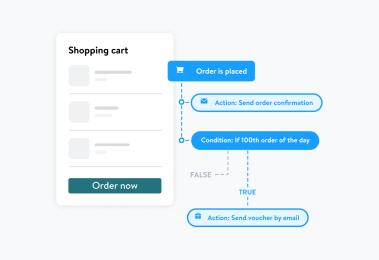
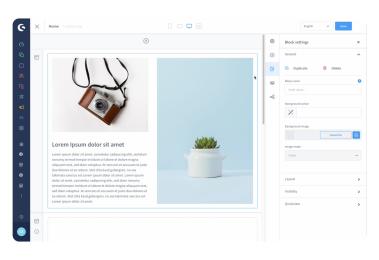
Let your content speak for itself! Make your storefront a stage to shine a spotlight on your products and your brand. Whether they’re in B2C or B2B, purchasing decisions are always emotional.
Discover more about Shopping Experiences