




With ecommerce SEO, you can strategically reduce your dependence on expensive ads (SEA). Since your shop system often automatically generates thousands of URLs, your technical configuration determines whether Google can efficiently find your products – or whether valuable crawl budget is wasted on unimportant pages.
Ecommerce SEO: the essentials at a glance
Technical foundation: A flat hierarchy (three-click rule) and fast loading times (Core Web Vitals) are the foundation for visibility and conversions.
Intent-based keywords: Optimize category pages for broader search terms and product pages for specific purchase queries (long-tail).
Value-driven content: Replace standard manufacturer descriptions with unique copy and guide-style content to build authority (E-E-A-T).
Structured data: Use Schema.org markups so prices, availability, and reviews appear directly in search results and AI overviews.
Clean control: Use canonical tags and intelligent filter navigation to prevent index bloat and duplicate content.
Mobile-first: Consistently optimize for smartphones, as Google primarily evaluates the mobile version of your store.
Shopware as your engine: Use the integrated SEO engine for automated sitemaps, hreflang tags, and SEO-friendly URLs to automatically eliminate technical sources of error.
How does the technical foundation of ecommerce SEO work?
The technical foundation of ecommerce SEO ensures that search engines like Google – or AI systems such as Gemini and ChatGPT – can fully understand your store without errors. It includes a flat site hierarchy for optimal distribution of link authority, excellent loading times (Core Web Vitals), comprehensive mobile-first optimization, and secure HTTPS encryption for maximum data protection.
Information architecture and internal linking
The structure of your store tells search engines which pages have the highest priority. With a flat hierarchy, you ensure that “link authority” flows from your homepage to even the smallest product page.
Three-click rule: Make sure that each of your products can be reached within a maximum of three clicks from the homepage. This shortens paths for crawlers and your customers alike.
Self-explanatory directories: Use clear URL structures such as domain.com/mens-shoes/sneakers/model-xyz. This helps search engines and AI systems immediately categorize your products correctly.
Use breadcrumbs: These navigation paths are doubly valuable for SEO. They improve internal linking and provide users with orientation – something Google often displays directly in search results.
Performance: optimize for users and algorithms
Google uses page performance, measured by the Core Web Vitals, to quantify user experience in your store. You should keep the following three metrics under control:
Loading time (LCP): How long does it take for your main content (for example, the product image) to become visible? You should aim for a value well below 2.5 seconds.
Interaction responsiveness (INP): How quickly does your store respond when a customer clicks a button? Your goal is a delay-free experience.
Visual stability (CLS): Prevent content from shifting while loading. This avoids misclicks and ensures a professional perception.
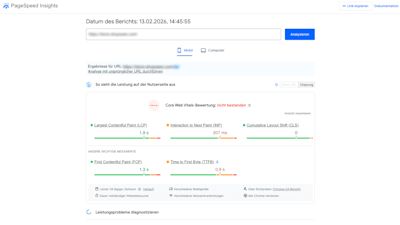
The PageSpeed Insights test measures your store’s performance.
Mobile-first: your most important version
Since the majority of ecommerce searches happen on smartphones, Google evaluates almost exclusively the mobile version of your store.
Ensure content parity: You must make sure that text, structured data, and images are exactly the same on mobile as they are in the desktop version.
Optimize usability: Your buttons must be large enough for touch interaction. This prevents high bounce rates caused by frustrated users.
Security and trust (HTTPS)
SSL encryption is essential. It protects your customers’ data and is a fundamental signal of your store’s integrity. Without HTTPS, you risk browsers displaying warning messages and search engines downgrading your store in rankings.
Technical checklist for ecommerce SEO
Search engines like Google and AI models such as Gemini or ChatGPT prefer clearly structured data. With the following elements, you increase the chances that your store ranks well and is cited as a primary source in AI-generated answers:
Canonical tag: Prevents Google from penalizing you for duplicates (for example, through filter URLs).
Robots.txt: Allows you to control exactly which areas (such as search results or the cart) should not be crawled.
Sitemap.xml: Notifies search engines immediately about new products or price changes.
Schema.org: Passes prices, availability, and reviews directly to Google Search for rich snippets.
How do I develop the right keyword strategy for my store?
You develop a strong ecommerce keyword strategy by filtering search terms based on intent and assigning them to the appropriate page types within your store. A successful strategy combines broad primary keywords (short-tail) for category pages with increasingly specific queries (long-tail) for product pages.
The keyword matrix: assigning the right intent
You should systematically group your keywords according to your customers’ search intent. In ecommerce, there are three essential categories:
Informational (knowledge need): Users are looking for solutions or comparisons (for example, “Which tent for winter?”). These keywords belong in your guide section or blog.
Commercial (purchase consideration): Users know what they want but not yet which model (for example, “hiking boots review”). Optimize these terms on your category pages.
Transactional (purchase intent): The search is very specific (for example, “buy Lowa Renegade GTX”). These keywords must lead directly to the corresponding product page.
Leverage long-tail potential
The more specific the search query (long-tail), the higher the probability that the user will make a purchase.
Search intent mapping: adapting your content
You must ensure that your page content delivers exactly what the user expects. If you optimize an informational keyword for a pure product list without explanatory content, you risk high bounce rates.
For category pages: Complement your product listings with helpful advisory content that supports users in their decision-making process.
For product pages: Focus on technical details, unique selling points, and clear purchase arguments.
Keyword type | Target page | Your goal |
|---|---|---|
Short-tail (e.g., “coffee”) | Homepage / main category | Brand authority & overview |
Mid-tail (e.g., “organic coffee beans”) | Subcategory | Specific product range depth |
Long-tail (e.g., “organic espresso beans dark roast 1kg”) | Product page | Conversion & level of detail |
How do I optimize my store pages (on-page)?
You optimize your on-page elements by aligning metadata, headings, and content with both the expectations of your target audience and the technical requirements of search engines. On-page optimization ensures that search engines like Google recognize your relevance for specific topics – and that AI models such as Gemini or ChatGPT can extract high-quality information to present your store as a trustworthy recommendation.
Building category pages (money pages)
Category pages are often the most important entry points for new customers. You should treat them as curated advisory pages – not just as pure product listings.
SEO copy with added value: Short introductory text above the products helps search engines match your page to the right topic. Detailed guide-style content further down increases depth.
Heading structure: Use a logical H hierarchy (H1 for the primary keyword, H2 for subtopics such as “Benefits of XY” or “Buying guide”).
Internal linking: From here, link to your top sellers and relevant blog articles to deliberately distribute authority within your store.
From description to conversion on product pages
The sale happens on the product page. You should avoid simply copying standard manufacturer descriptions, as this leads to duplicate content.
Unique content: Write your own benefit-focused descriptions. Don’t just explain features – explain the specific value for your customers.
Image optimization: Use high-quality images with descriptive file names (e.g., running-shoe-nike-air-red.webp) and meaningful alt tags. This helps Google Image Search and enables AI systems to correctly interpret the image content.
Integrate social proof: Customer reviews are dynamic content that search engines favor. They signal freshness and trust (E-E-A-T).
Meta data: your storefront in the SERPs
The title tag and meta description are your first point of contact in search results. You should treat them as a free advertisement and use them strategically.
Title tag: Place your primary keyword as close to the beginning as possible and add a unique selling point (e.g., “Free shipping” or “Wide selection”).
Meta description: Formulate a clear call to action (CTA) to increase your click-through rate (CTR).
How do I handle common SEO challenges in ecommerce?
You manage SEO challenges (such as duplicate content or an excessive number of URLs) by defining rules for your filter navigation and sorting functions. Clean technical control prevents search engines like Google from wasting resources on endless combinations of product attributes (index bloat). At the same time, you enable AI models such as Gemini or ChatGPT to correctly understand the logical structure of your assortment and properly categorize your products.
My ecommerce store generates too many URLs
Online stores often offer hundreds of filters such as color, size, or material. If each individual combination generates its own web address (URL), millions of pages with almost identical content can be created. You should prevent Google from crawling these low-value pages in bulk, as this can negatively affect the evaluation of your entire domain.
The solution is to guide the crawler. You have three important tools to bring URL chaos in your store under control:
Canonical tags: Set an “original reference” from the filtered page back to the clean category page. This tells Google: “No matter how users filter, this is the main page you should rank.”
Noindex directive: Instruct search engines to visit certain pages (for example, price filters or sorting by “lowest price”) but not include them in the search index.
Robots.txt: You can completely block entire areas of your store (such as internal search results or the cart) from crawlers. This saves valuable crawl resources.
Leveraging filter pages strategically
You should selectively make filter combinations indexable that people actually search for. These are the filters you should not hide.
Example: Almost no one searches Google for “running shoes + blue + size 44.” But the combination “running shoes + waterproof” is a valuable search query.
Your approach: Make such relevant combinations indexable via dedicated, readable URLs to capture this specific traffic.
Pagination: structure for subsequent pages
If your categories span multiple pages (page one, two, three, etc.), you must ensure that crawlers can find all products without getting lost. Use clear internal linking so search engines can easily navigate from the first to the last page.
SEO checklist for navigation and filters in ecommerce
Search engines like Google and AI models such as Gemini prefer a clear separation between relevant content and technical utility pages. Optimize your structure as follows:
Element | Your SEO action | Impact for Google & AI |
|---|---|---|
Relevant filters (e.g., by material or color) | Allow indexing (if there is search volume) | Additional rankings for niche keywords |
Sorting options (e.g., price) | Set to noindex, follow | Protects your crawl budget from being wasted |
Multiple filters | Use canonical tags pointing to the main page | Prevents penalties caused by duplicate content |
Internal search | Exclude from crawling via robots.txt | Avoids infinite, irrelevant URL paths |
How do I make my products visible for Google, Gemini, and ChatGPT?
You make your products visible by implementing structured data (Schema.org) in your store’s source code. This acts as a digital translation layer that converts information such as prices, availability, and reviews into a standardized format.
Search engines like Google use this data to display rich snippets (enhanced search results). AI models such as Gemini or ChatGPT use it to list and compare your products within AI overviews.
Schema.org for ecommerce SEO
You should treat structured data as a core component of your ecommerce strategy. Without this code in the background, search engines have to extract information from your design with significantly more effort.
Product markup: You provide the product name, description, brand, and image.
Offer markup: Here, you define the price, currency, and availability (for example, “In stock”).
AggregateRating: You show how satisfied your customers are by displaying star ratings directly in search results.
Rich snippets for ecommerce SEO
Even if you are not ranked in position one, you can generate more clicks with structured data. Rich snippets make your search result stand out from the competition.
Advantage: Results that include star ratings, price information, and availability achieve significantly higher click-through rates (CTR).
Trust bonus: A search result that immediately shows a product is in stock and has a 4.8-star rating appears more professional and trustworthy.
Optimization for Google AI Overview and LLMs
Generative AI systems “read” your store differently than traditional crawlers. They look for factual information that can be integrated directly into answers.
Tabular clarity: Provide technical data and product specifications in HTML or JSON-LD. AI systems prefer structured facts to create comparisons for users (for example, “Which cordless drill has the highest torque?”).
Merchant Center integration: Connect your store to Google Merchant Center. This data feeds Google Shopping and serves as a primary source for product recommendations in AI-driven search results.
Images and visual search
You should also prepare your images for visual AI search (such as Google Lens). High-quality images with metadata help AI identify your product visually and display it to users who use a photo as their search query.
How do I build authority and trust for my store?
You build authority and trust by optimizing the so-called E-E-A-T signals (Experience, Expertise, Authoritativeness, Trustworthiness). Search engines like Google use these signals to evaluate how credible your store and content are – protecting users from low-quality offers. AI models such as Gemini or ChatGPT also rely on these signals to determine whether they can mention your brand as a trustworthy recommendation in their responses.
E-E-A-T in ecommerce
In ecommerce, it’s about money – and your customers’ security. You should therefore demonstrate that real experts stand behind your store.
Experience & expertise: Publish test reports, guides, or video reviews that show you truly understand your products. Use author boxes for your blog articles to highlight the expertise of your editorial team.
Authoritativeness: You gain authority when reputable websites link to you (backlinks) or cite you as a source. You can actively work on this by building relationships with other website operators.
Trustworthiness: Ensure you have a complete legal notice and clearly visible shipping and return policies, as well as accessible contact options.
Backlinks in ecommerce SEO
Links from other websites function as digital recommendations for search engines. However, you should distance yourself from pure “link buying” and instead focus on high-quality backlinks that are earned through genuine value.
Content PR: Create studies, infographics, or unique guides that journalists and bloggers voluntarily link to.
Partnerships: Collaborate with partners within your industry to build topically relevant links that also generate real traffic.
Social proof and user signals
What customers say about you influences your rankings and how search engines and AI perceive your brand. You should actively manage reviews.
Integrate review systems (such as Trusted Shops or Google Reviews) on your homepage and directly within your product markup.
UGC (user-generated content): When customers upload photos of your products or ask questions, it enhances your page for search engines, as it signals interaction and freshness.
Your path to SEO success in ecommerce
Ecommerce SEO is the most important lever for reducing your dependence on rising advertising costs and establishing your store as an authority within your niche. You achieve the greatest success by combining a clean technical foundation with a comprehensive keyword strategy precisely tailored to your customers’ purchase intent.
When your store functions as a structured and trustworthy source of information for both search engines like Google and AI models such as Gemini or ChatGPT, you secure top positions in search results for the long term.
However, along the way, you will encounter typical challenges: Manually maintaining meta data for thousands of products is error-prone, technical conflicts caused by filter URLs often lead to duplicate content, and continuously optimizing loading times for Core Web Vitals requires deep technical expertise. Without a system that automates these complex processes, SEO quickly becomes a drain on resources.
This is exactly where Shopware comes in. With its integrated SEO engine, Shopware takes care of the heavy technical lifting and ensures that your content is perfectly structured and machine-readable.
Intelligent URL structures: Shopware automatically creates logical web addresses using customizable templates. You can define individual structures for each sales channel, such as your international store.
Automated meta data: You can maintain meta titles and descriptions individually for each page. If information is missing, the system uses automatic fallbacks – ensuring you never go live without optimization.
Automatic error prevention: From automated XML sitemaps to correctly implemented canonical tags, Shopware prevents errors such as duplicate content by default.
Global growth: Thanks to automatic hreflang tags, Google immediately recognizes which language version is the right one for your customers worldwide.
Performance boost: With integrated lazy loading, HTTP caching, and device-specific optimized image sizes, your store delivers the speed that Google rewards with strong Core Web Vitals rankings.
Secure migration: When URLs change, automatic 301 redirects protect the rankings you have worked hard to achieve.
Get to know Shopware!
Would you like to build more organic reach through SEO for your store and reduce long-term advertising costs? Discover the possibilities of SEO in Shopware now.
Ecommerce SEO – frequently asked questions and answers
What is the most important ranking factor in ecommerce SEO?
There is no single factor, but the combination of technical performance (Core Web Vitals) and a clear information architecture is particularly important. Only when search engines and AI systems understand your page structure – and your pages load quickly – can your content rank for relevant search terms.
How do I handle duplicate content for product variants?
You should use canonical tags. These indicate to search engines like Google which version of a product (for example, the primary color) is the original source. This prevents your store from losing relevance due to a large number of nearly identical URLs.
Why are structured data (Schema.org) so important for my store?
Structured data translates your store content into a machine-readable language. It enables search engines to display prices and reviews directly in search results (rich snippets) and serves as the primary data source for product recommendations in AI overviews.
How do I improve the SEO authority of my online store?
You increase your authority through high-quality backlinks and by building strong E-E-A-T signals. You can achieve this with expert articles on your blog, genuine expert reviews of your products, and transparent company information in your legal notice and “About us” pages.
Does a blog really help sell products?
Yes, a blog addresses informational search intent. Users searching for solutions to a problem (for example, “How do I care for leather shoes?”) discover your store through blog content. Through internal linking, you can then guide these potential customers directly to the relevant products.
How do I optimize my store for AI search?
AI models prefer direct answers and clear facts. Use tabular formats for product specifications, create precise FAQ sections, and ensure that all technical data is implemented as structured data within your source code.