



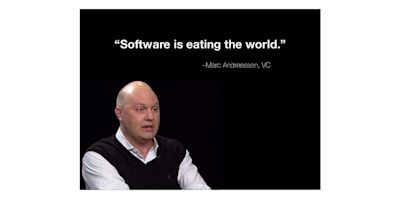
Back in 2011 Marc Andreessen dropped the line that still echoes through boardrooms: “Software is eating the world.” Thirteen years later the menu has changed. In my piece, "AI is eating ecommerce for breakfast – Agentic Commerce just took the first bite" I argued that autonomous agents would compress awareness, consideration and checkout into a single sub-second thought-chain.
Fast-forward to today and the evidence is everywhere. Andreessen Horowitz has now put a spotlight on the same shift with “How Generative Engine Optimization (GEO) Rewrites the Rules of Search,” showing why LLMs – not links – govern brand visibility . This article picks up where that GEO thesis ends and shows how agentic commerce turns model mentions into revenue.
What you’ll learn in the next few minutes
Why GEO beats SEO (and how reference rate replaces CTR).
How agents collapse "add to cart" into "already paid."
The three APIs every merchant needs to stay on the agent’s menu.
A 90-day action plan to make your store unforgettable to models and humans.
If software ate the world, agents are about to devour ecommerce.
1. The conversation starts at a16z – but it doesn’t end there
Zach Cohen and Seema Amble’s GEO-over-SEO thesis is spot-on: search is shifting from "ten blue links" to conversational answers, and visibility now means being referenced by a language model rather than ranked by a crawler. Yet once a model remembers your brand, the next logical step is obvious: let an agent act on that memory and complete the transaction. GEO wins you the mention, agentic commerce wins you the sale. Think of GEO as the air-cover and agents as the ground troops. One without the other is a half-measure.
2. Why GEO alone won’t close your cart
The a16z article highlights two structural shifts:
Paywalled AI replaces ad-funded search.
Reference rate replaces click-through rate.
Great – but paywalls and references do not move inventory. They create intent without execution. That execution layer is exactly what we are building with Agentic-Commerce.sh and the Agentic Commerce Alliance. In other words: the traffic of the future will not even see your lovingly optimized landing page. If your stack cannot talk API-to-API with an autonomous checkout bot, you are invisible at the moment of truth.
3. From GEO to “GEO × ACE” (Agentic Commerce Engine)
Old world | GEO world | Geo x ACE world |
|---|---|---|
Rank for keywords | Be referenced in model answers | Be referenced and transacted by agents |
Measure clicks | Measure reference rate | Measure completed agent orders |
Optimize HTML | Optimize machine-readable context | Provide live APIs for discovery, price, stock, payment |
GEO fixes discovery. ACE (Agentic Commerce Engine) fixes delivery. Together they compress awareness, consideration and checkout into a single conversational flow. Perplexity × PayPal’s in-chat checkout previewed this future already.
4. The three APIs every brand will need
API | What it does |
|---|---|
Describe | Rich, structured product data the LLM can cite |
Decide | Rules an agent can query: price floors, shipping limits, return windows |
Deal | Tokenized payment and fulfillment endpoints so the agent can finish the job in sub-second time |
These are the very protocols the Agentic Commerce Alliance is standardizing – open, merchant-first, no lock-in.
5. Metrics that marry GEO and agents
Stage | New KPI (source) |
|---|---|
Discovery | Reference rate in LLM answers ( a16z GEO report) |
Consideration | Bot trust score – % users letting agent decide (Agentic Commerce Alliance cheat sheet) |
Purchase | Agent conversion rate – completed orders per agent recommendation (Visa Intelligent Commerce) |
Loyalty | Autonomous re-order share (Shopware pilot data 2025) |
If your dashboards stop at reference rate you will celebrate brand salience while competitors swipe the revenue underneath.
6. A pragmatic roadmap (no buzzwords, just work)
12-Month agentic roadmap – lean, clear, actionable
Month 0–1 ▸ Get smart fast
Read both white papers on agentic-commerce.sh (Alliance PDF + cheat sheet).
Host a 60-minute "download" call with product, data and marketing leads.
Agree on one person to own "agent readiness" for the rest of the year.
Month 1–2 ▸ Make data edible for bots
Add missing attributes to your product feed (price, stock, lead-time, warranty).
Publish a describe endpoint (JSON/GraphQL) the bot can query.
Time-bound goal: feed completeness ≥ 90 %.
Month 2–4 ▸ Wire up the basics
Expose a decide rules endpoint (shipping limits, return windows, price floors).
Pilot a deal endpoint by connecting to Visa Intelligent Commerce sandbox for tokenized checkout.
Internal success metric: first end-to-end test order executes in < 1 second.
Month 4–6 ▸ Run a live pilot
Choose one low-risk use case (e.g. "re-order office consumables").
Release to 100 beta customers; track:
Iterate UX when bot trust < 70 %.
Month 6–9 ▸ Scale what works
Expand agentic flow to top 10 % of SKUs.
Plug your feeds into Profound/Daydream to monitor reference rate in LLM answers.
Aim for ≥ 5 % of GMV via agents by end of Month 9.
Month 9–12 ▸ Differentiate & measure
Add an "experience layer" (3-D try-ons, configurator, AR demo) for human shoppers.
Instrument returns API for near-instant refunds – target 95 % auto-approval.
Roll weekly dashboard: reference rate, bot trust, agent GMV, autonomous re-orders.
Output after 12 months
A production-grade describe–decide–deal stack.
At least one category where agents handle > 10 % of orders.
Clear metrics showing where to double-down next year.
Velocity beats perfection; the spec is evolving, so treat everything as an experiment in production.
7. Why Shopware bets its future on agents
Twenty-five years ago we built Shopware so merchants could own their storefront in a browser era dominated by Google. The same principle applies now: own your interface, even when the interface talks back. Our open plug-in architecture already exposes the Describe-Decide-Deal triad.
8. Your action checklist
Read the a16z piece – internalize the GEO argument.
Read through my white papers on Agentic Commerce – experience the operational edge.
Start experimenting and set up a "Velocity beats perfection" roadmap.
9. Closing provocation
GEO asks, "Will the model remember you?" I’ll add the follow-up:
"When the model remembers you, will its agent be able to buy from you – instantly, compliantly, and on your terms?"
If the answer is no, your beautifully optimized brand story ends as a footnote in someone else’s transaction log. Let’s not let that happen.
— Stefan

You might also be interested in:
Learn more about Shopware and Artificial Intelligence
Download the Agentic Commerce white paper
AI Insights #1: AI is eating ecommerce for breakfast
AI Insights #2: Unlocking the upside of agentic commerce
AI Insights #3: The playbook for machine to machine commerce