

In many industrial companies and technical wholesale organizations, digital sales are once again under close scrutiny. What was treated for years as a strategic transformation initiative is now being evaluated more pragmatically. The conversation has shifted away from innovation and feature depth toward profitability, efficiency, and margin stability.
The reasons are clear. Economic uncertainty, rising energy and procurement costs, and ongoing global volatility are increasing pressure on companies to reassess their fixed cost structures. According to recent McKinsey analyses, industrial companies worldwide are intensifying structural cost-reduction programs to remain competitive. This pressure does not stop at sales – and it does not stop at IT. It directly affects ecommerce.
In practice, a recurring pattern emerges: individual licensing models or hosting contracts are rarely the core issue. Instead, it is the accumulated structure of the digital sales architecture that systematically erodes margins.
Growth without an economic guardrail
Over the past decade, B2B ecommerce was often seen as future-proofing the business. Platform migrations, ERP integrations, PIM systems, customized pricing logic, and self-service portals were considered necessary investments. The objective was clear: build digital capabilities and fully meet customer expectations.
What was often missing, however, was an overarching economic framework. Rarely was it clearly defined what share of digital costs relative to online revenue would be acceptable, or what level of fixed cost exposure would remain sustainable long term. Instead, departmental requirements were implemented step by step – often evaluated in isolation and rarely challenged within a broader economic context.
The result in many organizations is a highly capable but cost-intensive architecture. Every integration is justified. Every customization makes sense in isolation. But taken together, the system creates structurally high operating costs.

The hidden dynamics of complexity
Complexity is not unusual in B2B environments. Customer-specific pricing, tailored product assortments, industry-specific logic, and differentiated approval workflows are part of the business model. It becomes problematic when every special requirement is implemented as a unique technical customization, creating permanent maintenance and adaptation overhead.
Customization generates not only initial project costs, but also long-term follow-up costs. Every special logic must be considered, tested, and documented during updates. Release cycles become more complex. Dependencies on implementation partners increase. Internal adjustments grow more difficult over time.
The structural challenge lies in distinguishing between value-creating differentiation and cost-intensive over-customization. Especially in economically tense periods, high fixed costs leave little room for maneuver when revenue stagnates or fluctuates.
Operational reality: Digitization without process simplification
Another critical factor affecting profitability lies in the operational processes behind the storefront. In many organizations, the online channel is technically integrated but not fully transformed from a process perspective. Orders are submitted digitally but reviewed or corrected manually. Prices are displayed online but validated again in the ERP. Customer data is maintained in multiple systems or reconciled outside the platform.
These hybrid structures permanently tie up internal resources. The expected efficiency gains from digitization fail to materialize, while personnel costs remain unchanged. Particularly problematic is that these efforts are rarely categorized as ecommerce costs – even though they are directly attributable to the digital channel.
In practice, companies often discover that the true process cost per online order is significantly higher than assumed. A thorough analysis of internal effort frequently reveals unexpected findings.
Typical structural cost drivers in B2B ecommerce
Across many projects, recurring patterns systematically burden margins:
High levels of customization in pricing and product logic
Duplicate data maintenance across ERP, PIM, and ecommerce platform
Manual post-processing of digitally captured orders
Lack of standardization in approval and authorization workflows
Dependence on external service providers for routine adjustments
These factors do not operate independently – they reinforce one another. The more complex the architecture, the greater the coordination required between IT and business teams. The greater the coordination, the higher the internal workload. And the more external partners involved, the higher the ongoing costs.
Total cost of ownership as a central management metric
A major weakness in many organizations is fragmented cost visibility. Project budgets are planned in detail, while ongoing operating expenses are often viewed only at a high level. Yet long-term economics are what ultimately matter.
Total cost of ownership includes not only licensing and hosting fees, but also internal resources, maintenance effort, release management, testing cycles, and complexity-driven follow-up costs. SaaS models in particular may appear transparent on a monthly basis, but over multiple years they can result in substantial fixed-cost commitments.
Only a holistic perspective makes structural margin pressure visible.
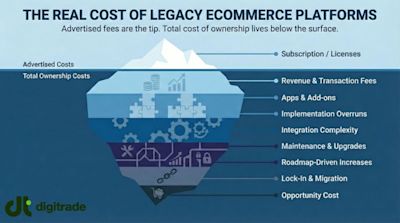
Figure: Structural cost drivers in B2B ecommerce beyond licensing and platform costs. Source: https://digi-trade.io/
Experience shows that the greatest margin impact rarely comes from visible software costs. Instead, it stems from structural complexity and operational inefficiencies.
A systematic assessment of total costs forms the foundation for sound economic management. A structured ecommerce cost and efficiency review makes it possible to capture all direct and indirect costs transparently and benchmark them against clearly defined target metrics. The objective is not short-term cost cutting, but sustainable margin stabilization.
Where to start improving structural efficiency
Companies aiming to improve the profitability of digital sales should not begin with individual contracts – they should start with structure. In practice, the following areas offer the greatest leverage:
Reviewing the degree of customization and standardizing wherever differentiation delivers no measurable business value
Eliminating manual process steps through clearly defined end-to-end workflows
Establishing clear governance for system changes and change requests
Strengthening internal capabilities to reduce external dependencies
Introducing transparent KPIs such as digital cost ratio and process cost per order
These measures create impact not individually, but in combination. Structural work is demanding, but it delivers the greatest long-term leverage.
Economic pressure as an opportunity for realignment
Current margin pressure forces companies to reassess their structures. What seemed manageable during growth phases becomes visible during economic strain. Inefficiencies surface more clearly. Dependencies become more obvious. Fixed-cost structures become harder to sustain.
At the same time, this period creates an opportunity to realign digital sales architecture. Organizations that reduce complexity, increase standardization, and systematically analyze internal process costs generate not only short-term relief, but long-term resilience.
Profitability in ecommerce does not happen by accident. It results from deliberate architectural decisions, clear governance structures, and disciplined financial management.
Conclusion: Margin is a structural decision
B2B ecommerce does not automatically become a cost driver. It becomes one when architecture, processes, and organization are not aligned with profitability. The key question is therefore not which license is too expensive, but whether the overall system operates efficiently.
Companies that create transparency around their digital cost ratio, realistically assess process costs, and reduce structural complexity secure a sustainable competitive advantage. Especially in times of increasing economic uncertainty, this is not an optional optimization initiative – it is a strategic necessity.
Digital excellence and financial discipline are not mutually exclusive. On the contrary: only their combination makes digital sales truly future-ready.

Further B2B insights
Download the B2B ecommerce compass to discover the six critical action areas companies must address now to build a resilient, high-performing B2B ecommerce business for the future.
Watch the B2B Future Forum, our webinar series where Shopware experts explain what’s changing in B2B commerce, why it matters, and how organizations can adapt strategically.
Discover Shopware’s modular solution for next-level B2B ecommerce