


Two dealers. Same product. Different prices. No one knows why. That’s how margin leakage starts.
A dealer places a bulk order. Later that day, another dealer calls. The sales team investigates. No one has a clear answer. The real problem is not pricing or product access on their own. It is the disconnect between the two.
If you cannot explain why two dealers see different prices within seconds, it shows that you have a control problem. This is not a technical issue, but it is a revenue risk. Small inconsistencies compound into delayed decisions.
Prices change in one system. Product visibility is controlled in another. When they do not stay aligned, errors look normal. That is where most businesses lose control.
It often begins with something small, like a manual pricing update or a quick change for one partner. Over time, these changes spread in ways no one tracks. What seemed like a simple fix starts to affect several dealers before anyone notices.
Sporting goods brands sell to a wide range of buyers. They work with dealers, distributors, and retailers, each of whom expects its own pricing and terms. Over time, pricing is shaped by contracts and long-term relationships. Catalogs become more selective and controlled.
Teams often manage this with spreadsheets, emails, and lots of follow-ups. This works for a while, but then mistakes start to happen. Wrong prices are shared, products go to the wrong partners, and dealers start to doubt the system.
According to Gartner, poor data quality costs organizations an average of $12.9 million per year
Margins begin to shrink in small ways. Operations slow down, and teams spend more time fixing problems than making progress.
Studies show poor data quality can lead to 20% lower productivity and up to 30% higher operational costs
At this point, many businesses begin exploring Shopware development services to regain control, clarity, and consistency across their dealer network.
What is dealer-specific pricing in B2B commerce?
Dealer-specific pricing means the same product can have different prices for different dealers. This is based on agreements, purchase volume, location, and dealer category. It replaces the idea of a single standard price for all buyers.
This model is essential in B2B. A large distributor buying in bulk will always expect a lower price than a small retailer. Similarly, long-term partners may receive better pricing than new dealers. These differences are part of how firms manage relationships and revenue.
There are several common pricing schemes used in this model. Contract pricing is based on negotiated agreements while volume pricing rewards larger orders. Region-based pricing adjusts for market differences. Level-based pricing groups dealers into levels, each with its own benefits.
In the sporting goods industry, this becomes even more important. Teams and retailers often place bulk orders. Demand changes based on sports seasons and events. Brands also control how products are distributed across markets.
Things get more complicated when one product has several prices at once. Dealers can also move between pricing tiers over time. Handling all of this by hand often leads to confusion and mistakes.
Without a centralized system, businesses struggle to preserve accuracy and grow operations. This is where Shopware migration services help shift from fragmented processes to a structured pricing system.
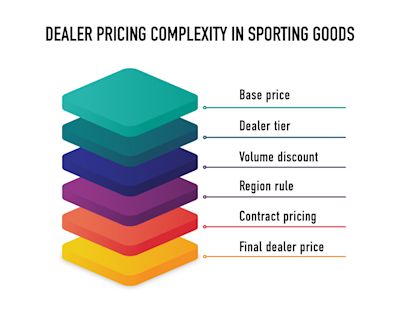
Pricing stages from base price through tiers, volume, and contracts
Key elements of dealer-specific pricing:
Contract-based pricing for negotiated deals.
Volume discounts for bulk purchases
Region-based pricing for market differences
Tiered pricing based on dealer category
Dynamic pricing that changes over time
Why it becomes complex:
One product with multiple active prices
Dealers moving across pricing tiers
Heavy reliance on spreadsheets and ERP
Lack of centralized pricing control
Difficulty scaling across large dealer networks
Why is dealer-specific pricing critical in the sporting goods industry?
Sporting goods brands often work with bulk buyers such as teams, academies, and retailers. Demand shifts with the seasons and sports cycles. To stay competitive pricing needs to adjust quickly.
Brands also manage how their products are distributed in different markets and setting the right prices helps them keep control and prevent conflicts between dealers.
What to do next:
Audit how many price versions exist per SKU today
Check if different dealers are seeing unintended overlaps in pricing
Identify where pricing rules are manually overridden
If pricing is not controlled at this level, you will see margin erosion across channels. It will not show up immediately. It shows up over time as inconsistent deals, untracked discounts, and reduced negotiating power.
What makes dealer-specific pricing complex to manage?
A single product might have several prices at the same time. Dealers can also change pricing tiers as time goes on. As the dealer network expands, managing all this by hand gets harder.
Many businesses still depend on spreadsheets or disconnected ERP systems. This leads to delays, mistakes, and lack of visibility.
What to do next:
Map your dealer tiers before defining pricing rules
List all systems currently handling pricing (ERP, Excel, ecommerce)
Check if ERP and ecommerce sync in real time
Without a central system, scaling becomes risky and inefficient. This is where structured ecommerce solutions and Shopware development services help bring control.
At small scale, teams compensate with manual fixes. At larger scale, those same fixes become failure points. What worked for 10 dealers will not hold at 100.
What is the hidden challenge of product access control?
Not all dealers should have access to every product. Sporting goods brands often handle premium product lines and exclusive distributor rights. Without proper controls, sensitive products can end up visible to the wrong dealers, which can cause pricing leaks and conflicts between partners.
Access control isn’t just about hiding products. It’s about making sure each dealer sees the right catalog at the right time. For example, a retailer in one region shouldn’t see inventory meant for another, and exclusive partners shouldn’t have to compete with open-market dealers for the same product.
If this isn’t managed well, businesses can run into big problems. Dealers might get access to restricted products, and retailers could end up competing with distributors. Over time, this can weaken the brand’s position in the market.
What to do next:
Audit which dealers can currently see premium or restricted SKUs
Verify region-based catalog restrictions are actually enforced
Test dealer logins to confirm correct product visibility
This is where structured systems and Shopware development services help enforce clear rules across catalogs.
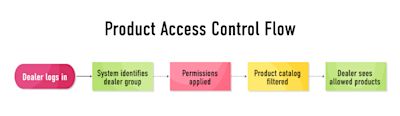
Stages from dealer login through permissions to product visibility
Key access control needs:
Restrict premium product visibility.
Control region-specific inventory
Protect exclusive distributor rights
Prevent unauthorized SKU access
Preserve brand value and positioning
What are the key challenges in managing pricing and access together?
Managing pricing alone is complex. Managing product access alone is also complex. The real challenge is not pricing or access alone. It is keeping both systems aligned at all times.Most businesses struggle because systems are not connected and processes are still manual. This disconnect is where pricing errors and wrong product visibility start to overlap and scale.
In many companies, the ERP system manages pricing and the ecommerce platform manages the catalog. These systems often don’t sync in real time, which can lead to dealers seeing incorrect prices or products. Manual updates make things worse, since teams have to adjust pricing for each product one by one.
This separation creates blind spots. Pricing may be correct in one system and wrong in another. The dealer only sees the final output. That is what they trust or question.
What to do next:
Check if pricing and catalog rules are managed in separate systems
Identify delays between pricing updates and catalog visibility changes
Review how often dealers report mismatched price vs product access
Scalability is also a problem. A system that works for 10 dealers might not work when you have 100 or more. Dealers may start to see inconsistent prices and products that don’t matter to them, which can hurt their trust in the brand.
Manual Management | Automated Management |
|---|---|
Excel-based pricing | Rule-based pricing engine |
High chance of errors | Accurate pricing |
Slow updates | Real-time updates |
Inconsistent pricing | Consistent pricing |
Hard to scale | Easy to scale |
Comparison between manual pricing and automated rule based execution
Poor dealer experience becomes the final impact. Confusing pricing and incorrect catalogs reduce order confidence and slow down sales cycles.
This is where a Shopware partner agency can help unify pricing and access into one controlled system.
How do modern ecommerce platforms solve pricing and access challenges?
Modern ecommerce platforms solve this by combining pricing logic and product access into a single system. Instead of manual updates, businesses define rules once and let the system apply them automatically across the catalog.
Rule-based pricing lets brands set conditions based on dealer type or order size. Once these rules are set, they apply to all relevant products automatically. This reduces mistakes and keeps things consistent.
Customer-specific pricing ensures that each dealer sees their own price when they log in. There’s no need for coupons or manual changes. Everything is set up in advance and shown in real time.
Role-based access control makes sure that dealers only see what they are allowed to see. Dealer groups, organization units, and permissions define catalog visibility clearly.
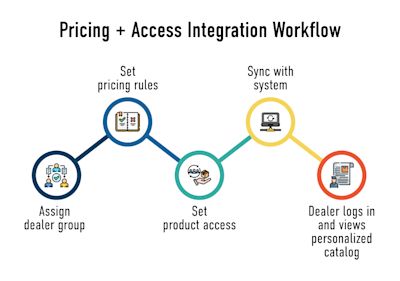
Stages from dealer setup through pricing rules to catalog access
Centralized control brings everything together. One dashboard manages both pricing and access, so there’s no duplication. Shopware migration services are especially helpful when moving from scattered systems to a single, unified platform.
Centralization is not about convenience. It is about control. Without it, every pricing rule and access rule becomes harder to track, audit, and trust.
How platforms solve it:
Rule-based pricing applied across catalog
Customer-specific pricing for each dealer
Role-based product access control
Centralized system with single dashboard
Decreased manual effort and errors
How does a real sporting goods brand manage dealer pricing and access?
A practical setup makes this clear. Consider a sporting goods brand that sells cricket gear and team uniforms. The brand works with multiple dealer types, each with different expectations.
Local retailers operate on standard discounts. Large distributors buy in bulk and expect better pricing. Exclusive partners get access to premium products that others cannot see. Without a structured system, managing this mix becomes difficult very quickly.
With a modern ecommerce system, everything runs on rules. When a dealer logs in, the system recognizes their type and instantly applies the right pricing and catalog rules. For example, one dealer might see a smaller catalog with standard prices, while another sees more products and bigger discounts.
There is no manual operation. Pricing and access are applied automatically based on preset logic. This ensures consistency among all dealers and removes dependency on manual processes. Many brands adopt this approach through Shopware development services to bring structure and control.
How the system works:
Dealer logs in and is identified by group.
Catalog visibility is filtered based on access rules.
Pricing is applied based on dealer type and volume.
Each dealer sees a personalized buying experience.
No manual pricing or catalog updates needed
What are the benefits of managing pricing and access together?
Managing pricing and product access in a single system gives you better insight and control. It helps reduce confusion for both your team and your dealers. When these parts work together, everything runs faster and more smoothly.
Margin control improves first. There are no accidental discounts or pricing leaks. Each dealer only sees the price they are meant to see. This protects profitability across all channels.
This is where leadership sees the impact. Fewer pricing errors. Fewer escalations. Clearer visibility into how revenue is actually generated.
Operations also speed up. Teams don’t have to update prices by hand or manage catalogs separately. Automation handles everything, saving time and cutting down on extra work.
Dealer trust also grows. When dealers see steady pricing and the right products, they feel more confident placing orders. This helps build stronger, long-term relationships.
Scalability becomes easier. Adding new dealers does not increase complexity. The same rules apply across the system. Errors also reduce since there is no dependency on spreadsheets or manual inputs. Many businesses achieve this level of efficiency after adopting Shopware migration services.
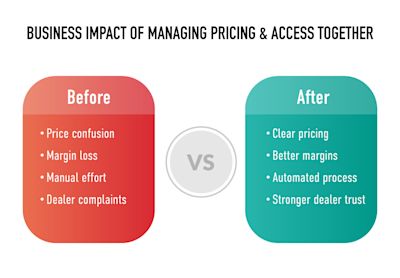
Outcomes from unified pricing and access across dealer operations
Key benefits:
Strong margin control with no pricing errors.
Faster operations with automated updates.
Improved dealer confidence and openness.
Easy scalability throughout large dealer networks.
Reduced errors and no spreadsheet dependency.
What is the role of Shopware development services in enabling this?
Shopware development services play an important part in building and customizing these systems. Every business has its own pricing models and dealer structures, so a standard setup usually needs to be tailored to fit real needs.
The first step is setting up custom pricing logic. This means creating advanced rules based on dealer type, product category, and order size. You can also set up complex dealer hierarchies to match real business relationships.
ERP integration is just as important. Pricing, inventory, and contract data need to sync between systems. Without this, inconsistencies will keep happening. Integration makes sure your ecommerce platform always shows up-to-date business data.
Building a dealer portal takes the experience even further. Each dealer gets their own login, with personalized pricing and product access. This makes the buying process smoother and more controlled.
Performance optimization ensures the system can handle big catalogs and lots of dealers without slowing down. A trusted Shopware partner agency can help set up and maintain this system for long-term growth.
What Shopware development services enable:
Custom rule-based pricing setup
Advanced dealer hierarchy management
ERP integration for immediate data sync
Personalized dealer portals with login access
Optimized performance for large-scale operations
When should you consider Shopware migration?
You should think about migrating when your current system starts to slow down your operations or create risks. Many sporting goods brands stick with old systems until mistakes and delays become common. By that point, inefficiency is already costing them a lot.
One common sign is when pricing is managed in Excel or other disconnected tools. Teams spend hours updating spreadsheets, and dealers still have to call to confirm prices. This shows there’s not much trust in the system. Frequent pricing mistakes are also clear warning signs.
As your dealer network grows, these problems get worse. What worked for a small group won’t work as you scale up. This is when Shopware migration services become essential to add structure and automation.
Shopware comes with built-in B2B features. It supports rule-based pricing and a system that can grow with your business. This lets companies move from manual work to a more controlled setup without adding extra workload.
Signs your system is failing:
Pricing managed in Excel or offline tools
Dealers calling to confirm pricing
Frequent pricing inconsistencies
Limited control over product visibility
Difficulty scaling dealer operations
Benefits of migrating to Shopware:
Built-in B2B features for pricing and access
Flexible system that adapts to business needs
Scalable setup for growing dealer networks
Decreased manual effort and errors
What are the best practices for implementing dealer pricing and access control?
To implement this successfully, you need clarity and discipline. Many businesses struggle not because of the technology, but because their setups are too complicated. Simple, clear rules work better than complex systems.
Begin by clearly defining your dealer segments. Group them by business value, region, or contract terms. This forms the foundation for both pricing and access control. Without clear groups, your rules can become inconsistent.
Don’t create too many pricing rules. Keep things simple and easy to manage. Making it too complicated leads to confusion and mistakes. Rule-based systems work best when the conditions are straightforward.
Integrate your ERP system early on. Pricing, inventory, and contract data should sync from the beginning. This helps prevent mismatches between systems and keeps everything accurate in real time.
Testing is essential. Check pricing and catalog visibility in different dealer scenarios before you go live. Finally, train your team so they know how the system works and how to manage it well. A good Shopware partner agency can help guide you through this process.
Best practices to follow:
Determine clear dealer segments from the start.
Keep pricing rules simple and structured.
Integrate ERP early for data consistency.
Test multiple dealer scenarios before launch.
Train teams to manage and maintain the system
Why is dealer-specific pricing and product access no longer optional?
Dealer-specific pricing and product access are closely connected and function best when managed together. When they are not aligned, inconsistencies, confusion, and additional manual effort can follow.
As dealer networks grow, these challenges tend to become more complex and harder to manage without a structured approach.
Taking time to review how pricing and access are currently set up can help identify gaps, improve consistency, and support smoother operations at scale. In many cases, it can be useful to consult with an experienced Shopware partner agency to assess current workflows and identify opportunities for improvement.

About the author: Ramanathan Ramakrishnamurthy
Ramanathan is a seasoned content writer at Ziffity Solutions, an IT services company. Specializing in digital trends, strategies, best practices, and technical insights, he collaborates closely with technical experts to deliver informative and engaging content. With over nine years of hands-on experience in ecommerce and digital technologies, Ramanathan brings a deep understanding of the field to his writing.
Further B2B insights
Download the B2B ecommerce compass to discover the six critical action areas companies must address now to build a resilient, high-performing B2B ecommerce business for the future.
Watch the B2B Future Forum, our webinar series where Shopware experts explain what’s changing in B2B commerce, why it matters, and how organizations can adapt strategically.
Discover Shopware’s modular solution for next-level B2B ecommerce