




Complexity in B2B is not the exception – it’s the norm. Even with a well-structured operating model, clear governance, and defined responsibilities, one core challenge remains: translating real-world business logic into digital systems. This is where many organizations begin to stall.
B2B ecommerce doesn’t scale based on how simple systems appear, but on how precisely they execute complex requirements. In Part 2, we explored why scaling is fundamentally an organizational question. This article addresses the next critical step: how to model industry-specific complexity so it becomes a foundation for scale rather than a constraint.
That brings us to the second strategic priority of the B2B Ecommerce Compass 2026 – the controlled, scalable management of industry complexity.
Action 2: Make industry complexity executable at scale
Digital usability in B2B does not emerge from simplification. It emerges when digital platforms accurately reflect real industry logic – the same rules, dependencies, and constraints that are still handled manually today across ERP, CRM, PLM, and service systems.
By 2026, generic B2B ecommerce has reached its limits. Buyers expect digital channels to behave like a true extension of operational reality: customer-specific pricing, regulatory checks, technical variants, approvals, availability, and lead times must be correct –in real time and across all channels. When this logic is missing or inconsistent, self-service collapses and manual work immediately returns.
Industry complexity is rising – system landscapes are lagging
B2B complexity is growing faster than most system landscapes can absorb. Customer-specific contracts, deep variant structures, role-based permissions, compliance requirements, and multi-ERP environments are now the norm across industries.
What consistently blocks scale is not the storefront, but execution across systems. This is confirmed by a survey across the Shopware partner ecosystem, which shows that 52% of total project effort is spent on integrations rather than frontend features or UX improvements. As B2B commerce matures, the focus shifts away from presentation toward building connected systems and stable data foundations that make business rules executable across channels.
This is no longer an IT challenge – it is an execution challenge.
Industry-specific requirements in B2B commerce
Challenge | Especially relevant for | Why it matters across B2B | Key systems |
|---|---|---|---|
Customer-specific pricing & contracts | Wholesale, Manufacturing, Distribution | Individual prices, discounts, and contracts are the norm | ERP, CRM, Pricing Engine |
Regulatory & compliance requirements | Chemicals, MedTech, Export Industries | Documentation, certificates, permissions affect most sectors | Compliance Systems, IAM, ERP |
Real-time product logic & variants | Manufacturing, Automation, Spare Parts | Dependencies and configurations must be correct digitally | PLM/PDM, ERP, CPQ |
Real-time availability & lead times | Wholesale, Distribution | Buyers expect reliable stock and delivery data | WMS/TMS, ERP, ATP Logic |
Automated ordering & B2B integration | OEMs, Key Accounts, Distribution | EDI, punchout, replenishment are baseline expectations | EDI, Procurement Systems |
Roles, approvals & permissions | Regulated Industries | Complex approval logic is now standard | IAM, ERP, CRM |
Data harmonization cross systems | All mature landscapes | Multiple ERPs and fragmented master data are universal | Integration Layer, MDM, PIM |
The integration layer as the real execution backbone
B2B complexity is not solved in the shop. It is solved in the integration layer. As industry logic becomes more granular and customer-specific, the integration layer becomes the operational backbone of B2B commerce.
It serves two critical roles:
Connecting core enterprise systems into a unified execution layer (including ERP, PLM/PDM, CRM, PIM, logistics, service, and identity systems)
Enforcing consistent business logic across channels, such as pricing, availability, permissions, and rules
By centralizing execution at this level, organizations reduce operational friction and manual intervention, while creating a reliable foundation for automation, marketplace readiness, and AI-driven workflows.
Partner lens

This perspective reinforces a central insight: scale in B2B is achieved not by simplifying the business, but by making its complexity executable. Make complexity invisible to the buyer Industry-specific commerce does not expose complexity – it hides it intelligently. Effective patterns include:
spare-part identification via serial or asset number
automated compliance and approval checks
customer-specific pricing logic
real-time ATP and lead-time calculation
guided configuration and variant filtering
Micro-UX elements such as exploded views, compatibility filters, and compliance indicators make complex structures usable without requiring buyers to understand internal system logic.
How companies put integration-driven execution into practice
In practice, successful B2B organizations do not solve complexity by adding more frontend features. They solve it by adopting middleware-based integration architectures that execute industry logic centrally and reliably across systems.

REIFF operates with multiple ERPs, regional assortments, and customer-specific pricing models. By implementing Shopware with a middleware-driven integration approach, REIFF centralized pricing, availability, and product logic across sales, portals, and marketplaces.
Impact: fewer manual corrections, consistent pricing across channels, and a scalable self-service foundation.
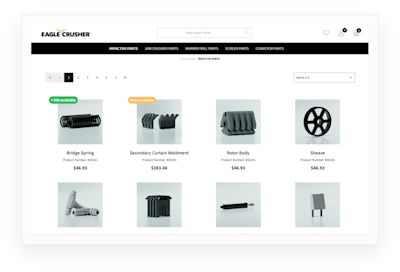
Eagle Crusher sells highly configurable industrial equipment with complex aftermarket logic. An API-first integration approach allowed variant rules, compatibility logic, and service data to surface directly in the digital experience.
Impact: fewer manual inquiries, higher buyer confidence, and a scalable foundation for complex B2B sales.
Recognizing integration as a critical execution capability in B2B commerce, Shopware has introduced Shopware Nexus. Nexus is designed to orchestrate commerce-relevant business logic directly within the Shopware ecosystem, reducing operational dependency on external middleware layers and enabling faster, more controllable execution across complex system landscapes.
Partner wrap-up: complexity as a permanent capability

Resolve complexity in the integration layer, not the storefront.
Translate real industry logic into executable digital workflows.
Connect ERP, PLM, CRM, and logistics systems through a stable backbone.
Automate pricing, variants, approvals, and availability rules.
Use micro-UX patterns to make complexity usable for buyers.
Treat industry precision as a baseline requirement – not a differentiator.
Complexity in B2B is not a problem to be solved. It is a capability to be mastered.
Organizations that attempt to simplify their business logic quickly reach their limits. Those that make it systematically executable lay the groundwork for true scale.
This elevates the integration layer to a critical role. It connects systems, translates rules into machine-readable logic, and ensures that digital processes run reliably – even as complexity grows.
With this foundation in place, the focus shifts from “How is execution managed?” to “How is buying enabled?”
Part 4 of this blog series explores hybrid buying – and why self-service and sales in B2B only work when designed as a unified system.
Is your system landscape ready for true B2B complexity?
Discover the five additional strategic priorities that help you operationalize complexity across systems and position your B2B ecommerce model to be intelligent and agent-ready. Download the B2B Ecommerce Compass 2026.