Over the past 15 years, B2B commerce has evolved from an overlooked niche into a strategic priority for manufacturers and distributors alike. In this edited interview, Andy Hoar reflects on what makes B2B fundamentally different from B2C, how the market has changed, and why cloud, composability, and agentic AI are reshaping the next phase of commerce.
You have been focused on B2B commerce since 2011. What drew you to this space so early?
Andy Hoar: When I started covering ecommerce at Forrester, almost everyone on the team was focused on B2C. But once I began sizing the market, it became clear that B2B was at least twice the size of B2C and still dramatically underserved. That immediately stood out to me. It was a large, important market that very few people were paying serious attention to.
When did you realize that B2B commerce was fundamentally different from B2C?
Andy Hoar: That became clear very quickly through conversations with practitioners at companies like Grainger, HP, and 3M. Their businesses were more complex, more sales-driven, and often deeply tied to branches, reps, contracts, and existing customer relationships. If I’ve heard one thing a thousand times, it’s this: people assume they can take a B2C platform, squint hard enough, and call it B2B. It doesn’t work that way.
What did the B2B commerce market look like in those early years?
Andy Hoar: Back then, the market was dominated by large, on-premise platforms. IBM WebSphere, Oracle, and Hybris were the big names, with SAP also in the picture. These were classic monoliths: expensive software, seven-figure license fees, and implementations that could cost many times more than the software itself and take years to complete. Compared with today, it was a very different world.
Why do you think B2B commerce was underestimated for so long?
Andy Hoar: In many companies, there was still a belief that ecommerce was secondary to the sales force, the branch network, or the traditional relationship model. Some leaders viewed it as a side channel or even a fad. But the companies that saw the change early, Grainger is a good example, invested sooner and built real advantages. They understood that digital was not replacing the business; it was becoming central to how the business operated.
What was the biggest technology shift in B2B commerce over the past decade?
Andy Hoar: Cloud was the biggest shift, without question. It lowered the cost of doing business and dramatically reduced time to market. Suddenly, companies were no longer locked into long, expensive, heavily customized on-premise implementations. The vendors that embraced the cloud moved ahead, and the ones that didn’t were left behind.
You later founded Paradigm. What gap were you trying to fill?
Andy Hoar: I saw two clear gaps. First, there was a need for research and advisory work that was truly focused on B2B commerce. Second, there was a big opportunity in the mid-market, meaning companies below the very largest enterprise tier, that were still large and sophisticated but not being served well by the big analyst firms. Those companies had real digital ambitions, but they were often overlooked.
Your B2B Combine takes a different approach from traditional analyst reports. Why?
Andy Hoar: Traditional analyst models tend to reward the best all-around decathlete. I wanted to identify the Usain Bolt in each category. In other words, I wanted to show where a vendor is truly world-class, not just broadly competent across a long list of features. That matters because buyers do not all need the same things. A company may not care about marketplace capability, for example, but it may care deeply about pricing, promotions, or B2B account management.
So how should buyers think about composable or partner-driven architectures?
Andy Hoar: They should think in terms of fit for purpose. Not every company needs one giant platform that does everything. In many cases, a more composable approach makes sense, especially if it lets a business plug in best-of-breed capabilities where they matter most. The key is to evaluate the total buyer experience, including complexity and total cost of ownership, rather than just checking boxes on a feature list.
What role do you think AI, and especially agentic AI, will play in the next phase of B2B commerce?
Andy Hoar: I think AI is the next major shift, on par with cloud. We are moving toward a world where agentic AI will have a real impact on how platforms are evaluated, how workflows are handled, and even how commerce experiences are delivered. The question is no longer whether AI matters. The question is how deeply it will reshape the architecture of commerce itself.
Do you think AI will change the role of the website in B2B?
Andy Hoar: It may. There are already serious conversations about whether websites will matter in the same way a few years from now if bots or agents are increasingly involved in discovery and purchasing. But even if the interface changes, the core commerce capabilities still matter. Businesses will still need systems that can monetize, transact, integrate, and support complex commercial relationships.
One theme that comes up often in B2B is community. Why is peer exchange so important in this space?
Andy Hoar: B2B is a more collegial environment than many people realize. Practitioners are often willing to share what worked, what didn’t, and which pitfalls to avoid because they are dealing with many of the same operational challenges. In B2B, the common enemy is customer attention, not necessarily each other. That is why peer communities, roundtables, and practical conversations are so valuable.
What is your advice to B2B companies evaluating commerce technology today?
Andy Hoar: Start with your real use cases, not abstract rankings. Be clear about what your business actually needs, what complexity you are trying to manage, and what capabilities will move the needle. Then choose technology that fits those priorities. The right platform is not the one that tries to do everything for everyone; it is the one that best supports your business model and your path forward.
B2B commerce is not B2C with a few additional features – it requires purpose-built processes, workflows, and buying experiences.
Cloud fundamentally changed the economics of commerce technology by reducing implementation complexity and accelerating time to market.
Composable architectures can offer greater flexibility when aligned with real business requirements.
Agentic AI is poised to become the next major platform shift, influencing everything from workflows to commerce experiences.
Successful technology decisions start with business needs and use cases, not analyst rankings alone.
Looking ahead
Over the past decade, B2B commerce has evolved from a niche discipline into a strategic growth driver for manufacturers, distributors, and brands. As cloud technologies mature and AI becomes increasingly embedded in commerce operations, businesses face a new challenge: balancing flexibility, efficiency, and long-term scalability.
For Andy Hoar, the answer remains the same as it was at the beginning of his B2B journey – start with the realities of your business, understand the needs of your buyers, and choose technology that supports your goals rather than chasing the latest trend.
About Andy Hoar
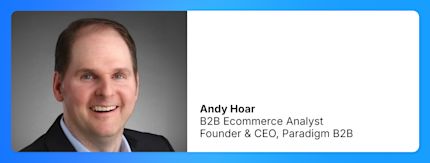
Andy Hoar is the founder and CEO of Paradigm B2B and a recognized expert in B2B ecommerce. Before launching Paradigm, he spent nearly a decade as a Vice President and Principal Analyst at Forrester Research, advising manufacturers, distributors, and commerce leaders on digital transformation and ecommerce strategy.
Further B2B insights
Download the B2B ecommerce compass to discover the six critical action areas companies must address now to build a resilient, high-performing B2B ecommerce business for the future.
Watch the B2B Future Forum, our webinar series where Shopware experts explain what’s changing in B2B commerce, why it matters, and how organizations can adapt strategically.
Discover Shopware’s modular solution for next-level B2B ecommerce