Outdoor Kitchen Store goes from no online sales to an agentic ecommerce operation with Shopware


Key facts:
Shopware version
Company
Technical features
Benefits of Shopware:

Configuration before customization
Shopware’s Rule Builder, Flow Builder, and native warehouse and shipping models carried requirements that would ordinarily need bespoke code. Multi-warehouse fulfillment, delivery eligibility, tax handling and order routing were configured in the platform rather than bolted onto it — enabling changes by the business without a development cycle.
A catalog that could be merchandised
Structured product data — media, features and normalised properties — turned price-list entries into products that could be found, filtered, compared and sold without a salesperson present.
Distributed fulfillment support
Multi-warehouse inventory with warehouse-specific order notifications, and postal code based shipping restrictions with dynamic customer messaging and order routing — all administered inside Shopware.
Rules the business can change
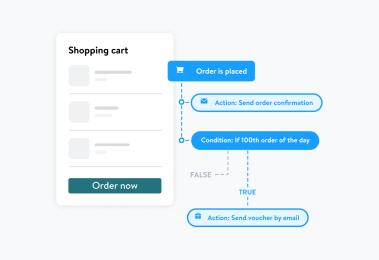
Shopware Rule Builder and Flow Builder automate tax processing, fulfillment logic, order routing and warehouse notifications while reducing the need for ongoing custom development.
Foundation for future growth
A scalable commerce platform with modern deployment practices, modular integrations and standardized deployment supporting ongoing platform development, giving a foundation for future enhancements as the ecommerce business continues to mature.
What next?
Bringing Outdoor Kitchen Store Online
When Outdoor Kitchen Store Outdoor Kitchen Store changed ownership, its new leadership saw an opportunity that hadn’t yet been explored. The company had built its reputation over more than twenty-five years through showrooms and warehouse operations, but customers couldn’t browse products or complete purchases online. The existing website presented the business; it did not sell anything. The gap was wider than a missing checkout experience. Much of the company’s product information had never existed in a form a website could use. For a large share of the catalog, the business held little more than a SKU and a price on a vendor price list — no description, no imagery, no specifications, no attributes.
"A lot of our catalog was a SKU on a price list and nothing else — no images, no specs, no description. Great products from great manufacturers, and we had almost no data on them. In a showroom that’s fine, because the salesperson knows the product. Online you can’t sell a SKU. Getting that data enriched from the manufacturers was the hardest part of this project, and everything else depended on it." — Joe Woods, Outdoor Kitchen Store
Building an ecommerce business from the ground up meant much more than launching a website. The new platform needed to reflect the way the company already operated, connecting inventory across multiple warehouse locations, routing orders correctly, and reducing the manual processes that supported day-to-day operations
The objective was straightforward: create an online sales channel without disrupting the business behind it.
Choosing the Right Commerce Platform
Before development began, Outdoor Kitchen Store evaluated several of the leading platforms in the commerce software space.
Most met a good share of the project’s requirements. Shopware ultimately offered the right balance of functionality, flexibility and cost. It gave the team the freedom to build the custom workflows the business required while providing a significantly more affordable implementation than the alternatives under consideration.
That flexibility would prove important. The project called for far more than a standard ecommerce deployment, requiring multi-warehouse fulfillment, tax automation, payment processing and specialized shipping and delivery rules — most of which the platform could be configured to carry rather than have written for it.
Ecommerce with Operational Complexity
Outdoor Kitchen Store's requirements extended well beyond a traditional online store.
Inventory was distributed across multiple warehouse locations. Orders needed to reach the appropriate fulfillment teams. Shipping eligibility depended on where customers were located. At the same time, the company needed to migrate its existing catalog into the new platform while preserving categories, variants, pricing, images, tax codes and cross-selling relationships.
Rather than treating each requirement as a separate project, the team built a single Shopware implementation that connected them into one commerce platform. Customers gained a modern online shopping experience while inventory, fulfillment, payments and tax processing continued to operate as an integrated system behind the scenes.
Configuring Shopware Around the Fulfillment Model
Outdoor Kitchen Store does not ship from one place. Stock sits across multiple warehouse and distributor locations, and an order has to reach the team that actually holds the item.
That model was built inside Shopware rather than around it. Warehouses are set up in the platform, and Rule Builder and Flow Builder handle the routing — matching each order to the right fulfillment location and sending warehouse-specific notifications automatically. No external system sits in the middle, and no custom application governs where an order goes.
Previously, warehouse communication required considerably more manual coordination. Automating those notifications simplified fulfillment and reduced the effort required to keep warehouse teams aligned as orders moved through the system. It also set the pattern for the rest of the project: solve the requirement in the platform wherever the platform can carry it, so the business keeps the ability to change its own rules later.
Building Checkout, Payments and Shipping Rules
None of this existed before. There was no online checkout to improve, no digital payment path and no automated way to determine whether an order could actually be delivered. Every one of these capabilities was built from nothing.
Avalara was integrated to automate sales tax calculations across U.S. jurisdictions — a requirement that only arises once a business sells across state lines rather than across a showroom counter. BlueSnap became the primary payment gateway, handling card processing for the storefront.
Shipping rules were built to reflect a genuine constraint of the business: outdoor kitchen equipment is heavy, freight-dependent and not deliverable everywhere. Rather than accepting orders the business could not fulfil, the platform validates postal codes against predefined delivery rules and displays location-specific messaging before checkout whenever restrictions apply. All of this is configured inside Shopware. The delivery rules, the freight and free-shipping tiers, the postal-code restrictions, the warehouse each order routes to and the tax treatment applied to it are set up in the platform using Rule Builder, Flow Builder and Shopware’s native shipping and warehouse models. They are not external customizations, and they are not a separate application sitting alongside the store. That distinction matters commercially as much as technically: when a distributor changes its freight terms or a product moves between warehouses, the business updates a rule rather than commissioning a change.
The result is that un-fulfillable orders are prevented at the point of purchase rather than resolved afterwards, and the rules governing tax, payment and delivery are administered in the platform rather than carried in the heads of the people who have always run the business.
From a SKU in a Price List to a Digital Catalog
Launching the new storefront required far more than importing product records. For a large part of the catalog, there were no product records worth importing.
Across roughly 4,285 products, a significant share existed only as an identifier and a price. High-quality products from premium manufacturers were represented by a line item and nothing else. An audit of one brand’s grill listings found 45% missing a title, 55% missing a description and 50% missing or carrying an invalid image.
In a showroom that is survivable. A salesperson knows the product, opens the manufacturer binder and answers the question. Online it is fatal. A SKU cannot be merchandised, cannot be filtered, cannot be compared and cannot be found in search. Those products were effectively unsellable in an ecommerce channel.
Where product data did exist, it arrived as inconsistent vendor spreadsheets and manufacturer PDF spec sheets, with formats, naming conventions and attribute labels varying supplier by supplier.
Outdoor Kitchen Store used Magnet Labs' CatalogIQ to close that gap, sourcing product specifics directly from the manufacturers and enriching records that had started as little more than an identifier. The output was structured product data in the form Shopware needs to merchandise well:
Media — product imagery attached to records that previously had none
Features — the descriptive content that lets a product be understood and sold
Properties — structured, normalized attributes that drive filtering, comparison, faceted navigation and fitment logic
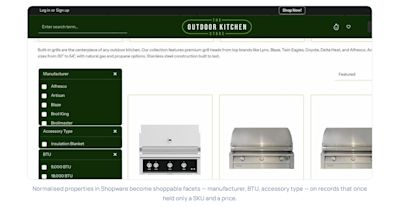
The enrichment was not a single pass, and the reason is instructive. The first sample runs largely failed. Where a record had no title, description or image, every enriched field came back flagged as having insufficient context — AI cannot generate product truth from an empty record. A second obstacle proved larger: the catalog’s category field held a navigational breadcrumb rather than a true product classification, so the platform could not reliably determine what a given product actually was, and attribute generation was skipped across a significant share of the catalog.
Those findings redirected the project. Before enrichment could deliver, Outdoor Kitchen Store had to repair the upstream catalog: build a real product classification distinct from the storefront breadcrumb, resolve placeholder imagery and close missing required fields. As Magnet Labs put it in their own audit, the limiting factor was upstream catalog completeness, not AI performance. The remediation worked — at the next review, data completeness had improved to the point that a single product in the entire catalog was still missing a price.
Enrichment then ran against a catalog it could actually read. Products were segmented by price band, with distinct editorial voice profiles applied so that a premium built-in appliance and a low-cost replacement part did not read in the same register. Across the premium bands, 432 products were enriched and catalog quality scores rose from approximately 20% to 72%, with gains in product page completeness, content quality, mobile readiness and product relevance. The balance of the catalog followed.
Alongside the enrichment, GoWide Solutions developed custom Python automation scripts and data extraction tools that validated, transformed and imported the catalog into Shopware while preserving categories, variants, pricing, media, tax classifications and cross-selling relationships.
The result was not simply a migrated catalog. It was a catalog that could be shopped — where products that had existed only as price-list entries became merchandisable, filterable, comparable items, rich enough to support the guided selling tools that followed.
Turning a Rich Catalog into Guided Selling
Structured product data made something else possible.
Buying an outdoor kitchen is not like buying an appliance off a shelf. A customer arrives with a space, a budget, a way they like to cook, and very little idea of what a complete installation actually requires. In a showroom, that gap is closed by an experienced associate who asks the right questions, notices what the customer has not thought of, and makes sure nothing essential is left off the order. Online, that person is missing — and the burden of knowing what to ask silently transfers to the customer.
Outdoor Kitchen Store now runs an AI shopping assistant, Jan Bot, built to close that gap.
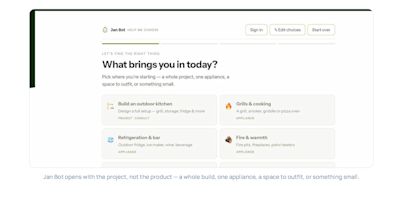
Jan Bot is designed to behave like that skilled associate rather than like a search box. It opens with the project, not the product: how much space is available, whether the installation is built-in or freestanding, what fuel is on site, how the customer actually cooks, whether this is a full kitchen or a single replacement part. From those answers it narrows thousands of possible configurations down to equipment that physically and practically fits — including a visual kitchen layout planner for customers working out how components fit a real space.
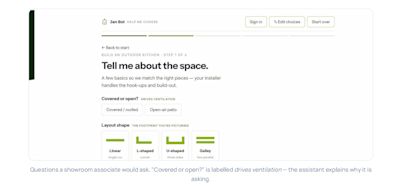
Where it really shines is in what the customer did not know to ask. A built-in grill and a freestanding cart of the same model take different mounting hardware and are not interchangeable — a distinction that produces a returned pallet when it is missed. A grill installed in an outdoor kitchen island needs an insulating jacket; the same grill on a cart does not. Covers, side burners, access doors and vent hoods each have their own compatibility constraints.
Jan Bot surfaces those requirements as part of the conversation — alongside spacing guidance, installation considerations and the kind of practical advice a good salesperson volunteers — instead of leaving them for the customer to discover after delivery.
"The effect is a change in who carries the work. Traditionally the shopper is responsible for knowing that a jacket is required, that a cover must match the exact model, that clearance requirements constrain the layout. Here the assistant carries that knowledge and collaborates with the customer on the decision, so what reaches checkout is a complete, compatible order rather than a best guess." - Joe Woods, Outdoor Kitchen Store
Customers can also save a project and return to it later, or pick it up on another device — because these purchases are rarely decided in one sitting.
The same structured data drives the automated fitment logic underneath: which covers, jackets and mounting components match a given grill, and which combinations will not work together. Customers see compatible options rather than a generic accessories list, which reduces both wrong purchases and the support burden behind them.
None of this would work on the original data. AI applied to inconsistent product data produces confident wrong answers; a fitment rule is only as good as the attributes it reads. Applied to enriched, normalised data, it can carry work that previously required an experienced salesperson on the showroom floor — which is precisely the capability a showroom business loses the moment it tries to sell online.
A Collaborative Implementation
The project touched nearly every part of the business — ecommerce, fulfillment, inventory management, payment processing, tax compliance and the product catalog itself. No single party delivered it. The work was carried by three groups operating together.
Outdoor Kitchen Store did not hand the project off. The company held product ownership and technical leadership in-house, defining requirements and priorities, making architectural and platform decisions, running the catalog and product data strategy, and directing the enrichment programme that the entire storefront depended on. That internal ownership is the reason the platform reflects how the business actually operates rather than a generic interpretation of a retail workflow.
GoWide Solutions provided the development capability and built the custom work the project genuinely required — the migration and import tooling, the storefront implementation and the storefront extensions behind guided selling — working directly against requirements set by the Outdoor Kitchen Store team rather than translating them at a distance.
Shopware’s professional services team was engaged alongside both, advising on platform architecture and on the right way to solve requirements within Shopware rather than around it. Several decisions that shaped the build — how far to extend the platform versus configure it — came out of that involvement.
Working this way — with the retailer owning the product decisions, a development partner building against them, and the platform vendor advising on both — is what kept the finished system aligned to the business instead of forcing the business to work around software limitations.
From a Brochure to a Business: A Foundation for Online Revenue Growth
Before this project, Outdoor Kitchen Store’s web presence did not sell. It presented the business, but every transaction happened in the showroom or over the phone. Online revenue was zero — not low, zero. For a specialty retailer in a category where customers research extensively before buying, that meant being absent from the part of the purchase where the decision actually gets made.
Today, Outdoor Kitchen Store operates its first centralized ecommerce storefront on Shopware, bringing together online sales, warehouse operations, inventory management, payment processing and tax automation within a single connected platform.
The store transacts online, fulfils through its distributor network, and is building awareness with customers who would never have walked into a showroom. Orders flow into the same systems that run the rest of the operation.
By configuring Shopware to match how the business already worked, developing only where the platform genuinely needed extending, and fixing the product data underneath both, the company established a scalable foundation for digital commerce while preserving the operational processes that support the business every day.
Features used in this case
Discover the power of innovative Shopware features - the core of our unique solution. Experience which of these features our customer has successfully used in their own case. Dive deeper into the details and use this inspiration for your own project.
Rule Builder
Define rules using conditions with the Rule Builder. Control pricing, shipping costs, promotions, and other logic.
Discover more about Rule Builder
Flow Builder
Automate business processes with the Flow Builder in one intuitive interface. Create workflows for tasks triggered by events without writing code.
Discover more about Flow Builder