


Artificial intelligence is everywhere. Hardly a day goes by without another announcement, a new tool, or even a bold prediction about how AI will transform the way we work. Organizations are investing heavily, experimenting with generative AI, building AI agents, and amongst it all, rethinking how work gets done. But at the same time,many leaders are questioning these decisions and asking themselves:
Where does real business value actually come from?
That was the central question I explored during my session at Shopware’s AI Superstars Summit. In my work with organizations across a wide range of industries, I see the same pattern time and time again: conversations focus on flashy new capabilities and models, while the actual business objectives often fade into the background.
The use of AI is not a goal in itself. What matters is the impact it has on revenue, customer experience, operational efficiency, and profitability.
That’s why I believe we need to rethink the way we talk about AI. Instead of chasing trends, we should focus on creating sustainable business value.
Why many AI initiatives start in the wrong place
One of the biggest mistakes organizations make when adopting AI is starting with the technology.
The question is often: “How can we use AI?” That’s the wrong starting point. A better question is: “What business problem are we trying to solve?” Only after answering that question does it make sense to evaluate whether AI is actually the right solution.
When organizations start with a tool, they often end up with projects that are technically impressive but fail to deliver proven value. The technology becomes the objective. The result is a series of pilot projects that generate attention but contribute little to long-term business success.
A personal example illustrates this problem well. My husband and I recently bought our first home and installed a new water heater. When we looked into its features, we discovered that it was marketed as “AI-powered.”
At first, the idea sounded reasonable. The system was designed to learn our showering habits and automatically heat water shortly before it predicted we would need it. The goal was to improve energy efficiency.
There was just one problem: it didn’t work. Not because the technology was flawed, but because the underlying assumption was wrong. My shower schedule is anything but predictable. Sometimes I shower in the morning, sometimes in the afternoon, and sometimes in the evening. There simply isn’t a reliable pattern to learn from.
Interestingly, the same technology would likely perform much better in a hotel or a gym. In those environments, the system is not trying to predict the behavior of one individual. It is learning from the patterns of many people. At that scale, the patterns become more reliable, making the predictions far more useful. The lesson here is that success depends just as much on choosing the right problem, often even more so, as it does on choosing the right technology.
Instead of starting with a tool, I encourage organizations to take a closer look at their processes and identify areas that are:
Slow
Risky
Error-prone
Expensive
These are the places where the most promising AI opportunities can be found. Start first by understanding the business problems and why it matters. The technology comes later.
Generative AI is only one piece of the puzzle
When people talk about AI today, most immediately think of ChatGPT, Gemini, or Claude. That’s understandable. Generative AI has captured everyone’s attention over the past few years and continues to do so by constantly introducing impressive new capabilities.
At the same time, it has created a common misconception: Many people now equate AI with generative AI. In reality, AI encompasses far more than generating text, images, videos, or code.
That’s why I distinguish between analytical AI and generative AI. Analytical AI helps organizations identify patterns, make predictions or recommendations, and improve decision-making. Generative AI, by contrast, creates new content based on existing information.
Both approaches are valuable. They simply solve different types of problems.
Analytical AI | Generative AI |
|---|---|
Supports decision-making | Creates new content |
Focuses on precision | Focuses on probabilities |
Similar inputs produce similar outcomes | Similar inputs can produce different outcomes |
Uses data for analysis and prediction | Uses data to generate new content |
This distinction matters because much of the business value created through AI has historically come from analytical AI rather than generative AI.
To better understand the broader landscape, it helps to look at the different categories of AI.
AI Category | What question does it answer? |
|---|---|
Descriptive Intelligence | What happened? |
Predictive Intelligence | What will happen? |
Prescriptive Intelligence | What should we do? |
Autonomous Systems | Can decisions be automated? |
Hyperpersonalization | What does this customer need? |
Computer Vision | What does the machine see? |
Natural Language Processing (NLP) | What are customers saying? |
Generative AI | What content can be created? |
Today, most AI conversations focus on generative AI. Yet it is only one of many categories through which organizations can create value. In digital commerce especially, some of the greatest opportunities lie elsewhere.
Hyperpersonalization helps deliver more relevant product recommendations. Predictive intelligence supports demand forecasting. Prescriptive intelligence can recommend inventory levels, marketing budget allocations, or operational actions. Natural language processing helps organizations better understand recurring customer inquiries and complaints.
Generative AI is undoubtedly a powerful tool. But it is only one tool among many.
Organizations that want to create long-term value should resist the temptation to chase every new AI trend. Instead, they should focus on a much simpler question: Which AI capabilities will help solve the business problem in front of us?
From AI adoption to business impact
When organizations talk about the success of their AI initiatives, they commonly focus on metrics such as usage, activity, or adoption. For example:
How many employees are using the tools?
How many prompts have been submitted?
How many workflows now include AI?
These metrics are easy to measure. The problem is that activity doesn’t necessarily translate to value, nor does usage to impact.
During my session, I discussed a trend referred to as “Tokenmaxxing.” The idea is simple: more usage must mean increased value for the business. More prompts. More users. More activity. Yet this way of thinking leads organizations in the wrong direction.
Despite billions of dollars being invested in AI, most organizations still struggle to demonstrate the true impact of their initiatives. Research from MIT’s Project NANDA highlights this challenge: approximately 95% of organizations have yet to achieve a measurable return on investment from their generative AI initiatives. Only around 5% have successfully translated those efforts into demonstrable business value. While I believe that percentage has improved somewhat since the study was published, the vast majority of organizations are still searching for ways to generate measurable returns from their AI investments.
That does not mean AI lacks value. It means many organizations begin with the wrong problems and measure the wrong outcomes.
Instead of asking how often a tool is used, we should be asking:
Are we making better decisions?
Are we improving the customer experience?
Are we increasing conversions and customer retention?
Are we creating measurable business value?
This is where a simple framework becomes useful: AI rarely generates revenue directly. More often, value is created through a chain of outcomes:
AI → Better decisions → Better experiences → Higher conversion and retention → Business value
Valuemaxxing pyramid:
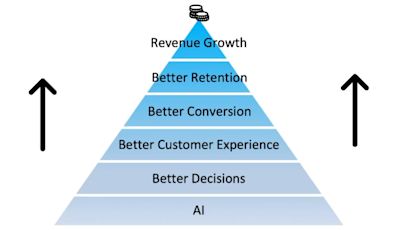
A simple ecommerce example illustrates this idea. Consider a product recommendation engine. The value does not come from the algorithm generating recommendations. The value comes from helping customers discover relevant products more quickly.
That improves the shopping experience. More visitors add products to their carts. Conversion rates increase. Customers return more often. Customer lifetime value grows. Only at the end of that chain does measurable business value emerge. That is why I prefer the concept of “Valuemaxxing” over Tokenmaxxing.
Successful organizations do not optimize AI usage. They optimize the value AI creates for their business.
Why augmentation outperforms automation in the long run
Another mistake I frequently see is viewing AI exclusively through the lens of automation. The conversation then revolves around a single question: Which tasks can we replace?
Contrary to what many believe, that is usually not the most promising approach. Some of the most valuable AI use cases emerge when technology helps people perform better rather than replacing them altogether. That’s why I distinguish between automation and augmentation:
Automation | Augmentation |
Replace | Amplify |
Cost-focused | Revenue-focused |
Efficiency | Effectiveness |
Short-term gains | Long-term advantage |
Automation absolutely has its place. Many repetitive tasks can be completed faster and more efficiently with the help of AI. But when organizations focus exclusively on automation, the conversation becomes centered on cost reduction.
Augmentation takes a different approach. The goal is to help people make better decisions, generate new ideas, solve complex problems more effectively, and, ultimately, deliver greater value.
That is why, when prioritizing AI initiatives, I tend to favor use cases with both high business impact and strong augmentation potential, such as AI-assisted customer service, intelligent merchandising support, and decision support tools.
Long-term competitive advantage comes from helping people achieve better outcomes with AI, not simply reducing the size of the workforce.
Why people remain the most important part of any AI strategy
One question comes up frequently: If nearly every organization now has access to the same models and the same AI tools, where does competitive advantage come from?
The answer does not lie in the technology itself. AI is rapidly becoming a baseline capability. The real differentiator comes from the combination of data, technology, and human capabilities.
That is why I use the concept of Engineered Intelligence, a framework developed by my colleague Jordan Morrow. The model consists of four components: Data + AI + IQ + EQ
SOURCE: 'Data & AI Skills: Gain the Confidence You Need to Succeed,' Jordan Morrow
The first two components are fairly straightforward. Data provides the foundation. AI helps scale insights and support decision-making.
The real differentiators, however, lie in the final two components:
IQ represents human knowledge, experience, and critical thinking.
EQ represents communication, empathy, and judgment.
As AI becomes more widely adopted, these capabilities become more important, not less.
People remain responsible for tasks such as:
Defining the right problems
Evaluating context
Challenging outcomes
Recognizing exceptions
Taking accountability
AI can generate content. AI can identify patterns. AI can make recommendations. AI can even automate routine tasks. But AI does not decide which goals are worth pursuing. Nor does it take responsibility for the consequences of its decisions.
The technology is rarely the hardest part. Helping people embrace new ways of working is where most organizations struggle. Why? Because we underestimate the human element.
Five questions to ask before launching any AI initiative
Before wrapping up, I’d like to conclude with five questions that I have found particularly useful.
Before investing in a new AI initiative, ask yourself:
What business outcome are we trying to improve?
How will we measure success?
Is AI truly the best solution to this problem?
Are we helping people perform better, or are we simply trying to replace them?
Who is ultimately accountable for the outcome?
These questions may appear simple at first glance. In my experience, however, they are incredibly effective at keeping organizations focused on what matters most: creating sustainable business value.
Conclusion
The organizations that will thrive are those that use AI with purpose. They are the ones who focus on using AI intentionally, solving real business problems, measuring meaningful outcomes, and, most important of all, tying it all back to real value.
Technology is only one part of a successful AI strategy. Lasting value comes from the combination of data, AI, and human judgement.
Or put another way: Every successful AI strategy begins and ends with people.
Keep the conversation going
This article is based on my session at Shopware’s AI Superstars Summit.
If you’d like to explore these topics in more depth, you’ll find not only the replay of this session, but also additional presentations from experts in AI, data, digital commerce, and agentic commerce.
What you can expect:
20+ industry experts
10+ sessions featuring real-world use cases
Practical insights and strategies from digital commerce leaders
Free registration
Access to session recordings and additional resources after registering
Whether you join a live session or watch the recordings later, registration gives you access to all available summit content.
Discover Shopware Intelligence
Successful AI initiatives begin with the right questions, the right data, and clearly defined business objectives.
Shopware Intelligence helps merchants make data-driven decisions, streamline commerce operations, and integrate AI directly into their existing workflows. From intelligent insights to agentic capabilities, it creates an environment where people and AI can work together more effectively.
FAQ – frequently asked question
Why do so many AI projects fail despite significant investment?
Many AI initiatives start with the technology rather than a specific business problem. Organizations invest in new tools but often fail to define the outcome they want to achieve. Without clear goals and success metrics, it becomes difficult to create measurable value. Successful AI projects do not begin with the question, “How can we use AI?” They begin with the question, “What problem are we trying to solve?”
How should organizations measure the success of AI initiatives?
AI success should not be measured by usage metrics such as the number of prompts, active users, or use cases. What matters are business outcomes. These may include higher conversion rates, stronger customer retention, better decision-making, improved operational efficiency, or a positive return on investment. The true value of AI is reflected in its contribution to business performance.
What is the difference between analytical AI and generative AI?
Analytical AI helps organizations analyze data, identify patterns, and make predictions. It is commonly used for applications such as demand forecasting, product recommendations, and risk detection. Generative AI, on the other hand, creates new content, including text, images, code, and audio. Both approaches serve different purposes and can complement each other when applied to the right business challenges.
Should organizations focus on automation or augmentation?
Both approaches have value. Automation is particularly effective for repetitive tasks and can improve efficiency. Augmentation takes a different approach by helping people make better decisions, work more productively, and solve complex problems faster. In most cases, the greatest long-term value comes from using AI to enhance human capabilities rather than replacing them entirely.
Why do humans remain a critical part of successful AI strategies?
AI can analyze information, identify patterns, generate recommendations, and automate certain tasks. However, accountability, context, critical thinking, and strategic decision-making remain human responsibilities. People define objectives, evaluate outcomes, and take ownership of the consequences. As AI becomes more widely adopted, human judgment, expertise, and empathy become even more important.
About the author
Christina Stathopoulos is a global keynote speaker, award-winning educator and Founder of Dare to Data, helping individuals and corporations take the next step in their data and AI journey. After building a successful career leading data strategy at Google and Waze, she shifted her focus to scaling impact through education, training and product evangelism. Today, she is trusted by an extensive client list of Fortune 500 and Big Tech organizations. Christina also holds an Adjunct Faculty position at IE Business School and Porto Business School, where she leads programs and lectures on harnessing the power of data and AI for business. She is a highly sought-after public speaker, delivering keynote talks to audiences of thousands across more than 20 countries to date. She also serves as an instructor for LinkedIn Learning, hosts a podcast for EM360Tech and is an outspoken Ambassador for responsible AI.