

B2B buyers no longer wait for sales reps to complete routine tasks – but many organizations still force them to. Reorders, price checks, spare parts purchases, and account management often remain tied to manual processes, fragmented systems, and disconnected sales interactions. The result: slower buying journeys, rising operational costs, and frustrated customers on both sides of the transaction.
In Part 3 of the B2B Ecommerce Compass 2026 series, we explored how industry complexity must be translated into scalable digital processes instead of becoming a bottleneck for growth. But operational complexity alone is not the challenge. The next strategic question is how buyers and sales teams interact within those processes.
This article explores the fourth strategic priority of the B2B Ecommerce Compass 2026: Hybrid Buying. We examine why self-service has become the default for routine transactions, where human sales expertise still creates value, and how leading B2B companies combine both into one connected buying journey.
Action 3: Make hybrid buying the default operating motion
Hybrid buying is no longer an emerging pattern in B2B – it is the operational reality. Buyers do not follow linear journeys from digital research to sales engagement. Instead, they move fluidly between autonomous self-service and targeted human support, depending on task complexity, risk, and decision impact.
As our partner intoCommerce highlights based on its implementation experience:

Beyond buyer expectations, internal efficiency pressure is driving hybrid buying. Budget constraints and operational complexity force tighter coordination across sales, service, and digital channels.

Self-service for standard tasks (rep-free by design)
Routine B2B transactions increasingly belong in digital workflows. Buyers expect to complete standard tasks independently, without waiting for human interaction, follow-ups, or approvals.
Typical self-service use cases include:
repeat orders and replenishment
simple spare parts and consumables
reorders via portals, EDI, or punchout
real-time price and inventory checks
When designed as the default, self-service absorbs a large share of transactional volume. This lowers operational effort and cycle times, improves buyer satisfaction, and frees sales and service teams from low-value work.
Sales for complex decisions (where expertise adds value)
B2B buying remains inherently complex. High-value or highly customized purchases still require human expertise and trust.
Sales involvement remains essential for:
solution selling instead of individual SKUs
machines, systems, and project-specific configurations
custom quotes, discounts, and contract negotiations
approvals, exceptions, and compliance-driven decisions
In a hybrid model, sales is not displaced – it is elevated. Sales teams focus on consultative work, solution design, and risk mitigation, rather than transactional execution.
One combined journey – not two parallel channels
Hybrid buying only works when self-service and sales assistance are part of one continuous journey, not two disconnected motions. Buyers must be able to start digitally, decide how much autonomy they want at each step, involve sales when it adds value, and continue without friction or data loss.
Key enablers include:
CPQ, to bridge configuration and quoting across channels
Guided selling, as a structured selection aid for complex buying decisions
Digital Sales Rooms, to centralize collaboration, documentation, and approvals
Clear handoffs between platform and sales, based on shared data and rules
Without this integration, organizations experience broken handoffs, inconsistent pricing, duplicated effort, and declining trust.
A practical example shows how hybrid buying works when self-service and assisted selling are designed as one connected journey.
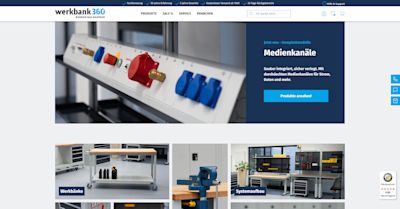
Werkbank360’s buyers needed to configure modular workplace equipment quickly and with certainty. In the previous setup, many variants were listed as separate products and shipping conditions differed by customer group and order status. This was slowing comparison and increasing checkout questions.
Over 10 months, Werkbank360 migrated with intoCommerce from Shopware 5 to Shopware 6 with a redesign and a plate configurator. The catalog was consolidated into a variant model to reduce article count, while shipping was implemented through rules based on customer group, product, and status. The configurator was connected via API, and import/export was extended with profiles plus a PIM connection, enabling faster in-house updates and shorter time-to-market. Go-live happened without downtime; results included +25% purchases, +57.3% item impressions, and +116.3% revenue. The learning for Hybrid Buying 2026: build strong self-service for routine steps, so assisted buying can focus on exceptions and advisory value without breaking the journey. This matters because 83% of B2B buyers want self-service portals and standard inquiries represent 26 - 75% of request volume in many companies.
Key takeaway: Remove routine uncertainty digitally and use human support where it creates real decision value.
Hybrid buying is no longer about choosing between digital commerce and sales interaction. Leading B2B organizations combine both into one connected journey – using self-service for speed and efficiency, while reserving human expertise for high-value and complex decisions. Companies that successfully balance autonomy and assistance reduce friction, scale more efficiently, and create better buyer experiences across every touchpoint.
With this foundation in place, the focus shifts from “How is buying enabled?” to “How is trust maintained across every interaction?”
Part 5 of this blog series explores why real-time data has become the foundation of trusted commerce – and why accuracy, consistency, and transparency are now critical buying criteria in B2B.
Is your system landscape ready for true B2B complexity?
Discover the five additional strategic priorities that help you operationalize complexity across systems and position your B2B ecommerce model to be intelligent and agent-ready. Download the B2B Ecommerce Compass 2026.