
AI is changing how people discover products, compare options, and make purchase decisions. But adding AI to an ecommerce store is not the hard part.
The harder question is this: Can your commerce architecture support AI without forcing you to rebuild the business every time technology changes?
That is where open commerce architecture becomes important. It gives businesses the flexibility to connect and change different technologies without having to rebuild the entire commerce platform.
The mistake businesses risk making is architecting for the AI capabilities they need today rather than the flexibility they will need tomorrow. AI models, agents, and customer interfaces will continue to change. An architecture built around one technology choice can quickly become a constraint.
The true aim should be to create commerce systems that are able to adopt, replace, and integrate AI technologies without disrupting the main business operations. Instead of designing with today's AI in mind, we should design with the capability of replacing tomorrow's AI in mind.
NIQ's research carried out in August 2026 found that 74% of shoppers now use AI as part of their product discovery. The same report revealed that 20% of consumers already use AI as part of their shopping process. These findings show how AI is changing the way people shop. Businesses need commerce systems that can adapt to these changes and support new technologies.
When businesses are investing in Shopware development services, the discussion has gone beyond storefront features. Today's ecommerce requires connected data, flexible APIs, modular services, and the ability to introduce new technologies without having to replace the whole commerce stack.
Shopware's API-first and open approach is designed for this kind of flexibility. It allows commerce capabilities to connect with external systems, custom frontends, applications, and emerging digital experiences.
As AI moves from a tool used by employees to an active participant in the buying journey, that flexibility could become a core architectural requirement.
What is open commerce architecture?
Open commerce architecture is an approach where the commerce platform can connect with other systems through APIs and modular services. The commerce engine does not have to control every part of the customer experience.
This allows businesses to connect systems such as ERP, PIM, CRM, WMS, search platforms, marketplaces, payment services, and AI applications. Each system can handle the function it is designed for while sharing relevant data with the rest of the ecosystem.
Shopware describes its platform as API-first and supports headless commerce, custom storefronts, integrations, and API-based applications. Its APIs provide access to commerce capabilities that can be used by external applications and experiences.
The important point is not simply that systems can connect.
It is that the business retains flexibility over how those systems evolve.
A new search engine should not require a complete storefront rebuild. A new customer experience should not require replacing the commerce engine. An AI service should not need to become permanently embedded into the core platform.
What is open commerce architecture?
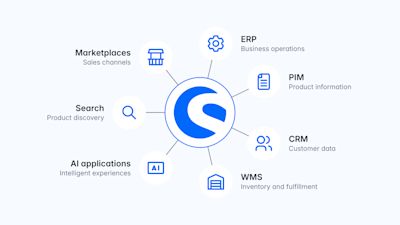
Shopware connects commerce with ERP, PIM, CRM, WMS, search, and AI.
What does your current ecosystem look like?
Start by mapping the systems connected to your commerce platform. Identify where product data, customer information, pricing, inventory, orders, and content originate.
Then ask whether those systems communicate through well-defined APIs or through fragile custom connections.
That simple exercise can expose architectural dependencies that may become expensive as the business grows.
Why does open architecture matter more in the age of AI?
AI applications need access to information and business capabilities.
Consider an AI shopping assistant. A customer may ask for a product recommendation based on price, availability, delivery location, previous purchases, and product specifications.
The AI needs more than a language model to answer that request.
It may need product information from a PIM. It may need inventory data from an ERP or warehouse system. It may need customer information from a CRM. It may need pricing and promotions from the commerce platform.
Now consider what happens when the customer decides to buy.
An advanced commerce agent may need to create a cart, apply an eligible promotion, check stock, and start the checkout process.
That requires controlled access to commerce functions.
This is why AI makes architecture more important.
AI can generate an answer without deep integration. AI that performs useful commerce actions cannot.
What are businesses getting wrong when they build for AI?
Many businesses treat AI as something they are buying rather than as a decision that involves changes to their overall structure. They choose a model, decide on a use case, and start with the integration process before they have worked out whether their current systems can provide the necessary data access and business functions.
This creates three risks:
The reliance on technology in this case makes it difficult to switch to another AI provider since the core workflows are based on one such provider.
When data is fragmented, it can lead to unreliable recommendations and actions if AI is connected to incomplete or inconsistent information.
There is limited control: if AI is given access to business functions without having clearly defined permissions, this can lead to operational and security risks.
The right approach is not to postpone the adoption of AI; rather, it is to set up the necessary architecture, data access, and controls so that AI capabilities can develop without generating unnecessary dependencies.
The platform direction that Shopware has recently taken is an indication of this change. When the company held the Shopware Community Day in 2026, it set out its vision for an open commerce infrastructure in the agentic era and stressed the need to combine data and business logic in order to provide context for AI.
What does AI need from your commerce architecture?
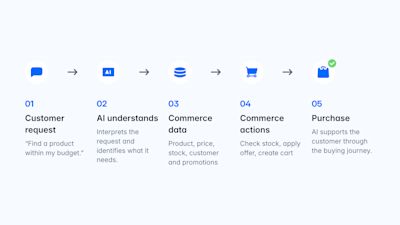
AI uses commerce data and controlled functions to support purchases.
What is the practical takeaway?
Before starting an AI project, list everything the AI needs to read and everything it may eventually need to do. Then check whether those capabilities are available through secure APIs.
If they are not, the architecture may need attention before the AI project can scale.
Before investing in AI, ask:
What business data will the AI need?
Where does that data live today?
How reliable and current is it?
Which commerce functions will AI eventually need to access?
What should AI be allowed to read, recommend, and execute?
Can we replace the AI provider without rebuilding the integration?
These questions help decision-makers assess whether the business is ready for AI adoption or needs to address architectural dependencies first.
One part of this flexibility is the ability to separate the customer experience from the commerce backend. This is where headless commerce comes in.
How does headless commerce support AI?
Headless commerce separates the presentation layer from the commerce backend.
The frontend communicates with the backend through APIs. This gives businesses greater freedom to build different experiences while keeping core commerce functions in place.
Shopware supports headless implementations and provides APIs that can be used to create custom commerce experiences.
This is useful in an AI-driven environment because new interfaces may emerge quickly.
The next major commerce touchpoint may not look like today's ecommerce website.
It could be a conversational shopping assistant. It could be an AI-powered product discovery experience. It could be a voice interface. It could be an application embedded into another digital service.
A headless architecture gives businesses more options for delivering these experiences.
But there is an important distinction.
Headless does not automatically mean AI-ready.
A business can have a headless storefront and still struggle with fragmented data, poor APIs, complex integrations, and tightly coupled backend processes.
Headless is one architectural capability.
Open commerce requires the wider system to be flexible as well.
What should businesses evaluate beyond the frontend?
Look at the backend capabilities exposed through APIs.
Can an application retrieve product information? Can it check availability? Can it access pricing rules? Can it create carts? Can it retrieve order information?
The answers will show whether the architecture can support more advanced digital experiences.
The real question is whether the architecture can evolve without disrupting core commerce operations. It is advisable for businesses to consider if they can introduce new frontends, integrate AI services, and replace individual components without having to rebuild the whole system.
Headless commerce vs AI-ready commerce
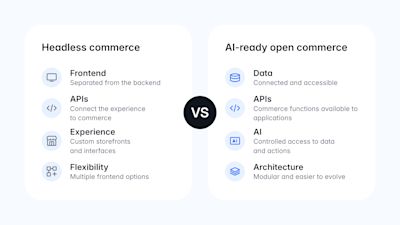
Headless separates frontend experiences from backend commerce capabilities and data.
Why is data architecture critical for AI commerce?
AI needs context.
A product recommendation based only on a product description is limited. A recommendation based on product attributes, availability, customer requirements, pricing, delivery options, and purchase history can be much more useful.
That information often exists across several business systems.
Commerce data | Possible source | Why AI may need it |
Product attributes | PIM | Product discovery and recommendations |
Inventory | ERP or WMS | Availability and fulfillment |
Pricing | Commerce platform | Accurate purchase decisions |
Customer profile | CRM | Personalized experiences |
Order history | Commerce platform or ERP | Customer support |
Promotions | Commerce platform | Relevant offers |
Content | CMS or PIM | Product education |
This creates a fundamental challenge.
AI cannot provide reliable commerce experiences if the underlying information is incomplete, outdated, or inaccessible.
That means AI readiness starts with data quality.
A sophisticated model cannot compensate for incorrect inventory data.
An AI assistant cannot provide accurate product comparisons if product attributes are missing.
And a shopping agent cannot complete an order if it cannot securely access the required commerce functions.
What should businesses do with their commerce data?
Start with the information that directly affects buying decisions. Check its source, ownership, accuracy, update frequency, access controls, and API availability.
Do this before introducing an AI layer. It is usually easier to fix a data problem before AI becomes dependent on it.
Before investing in AI, decision-makers should ask:
Is our business data accurate and accessible?
Can AI access trusted information across systems?
Who is accountable for data quality?
Can we trace the information behind AI-generated decisions?
AI readiness depends on data quality and governance and not just access to technology.
Can open architecture reduce technology lock-in?
Technology changes quickly.
This is particularly true with AI. New models, AI platforms, agents, search technologies, and customer interfaces continue to appear.
A business that tightly embeds one technology into its commerce platform may find it difficult to change later.
Open architecture can reduce that dependency by keeping services modular.
For example, an ecommerce business might use one AI provider for product recommendations today and evaluate another provider later. If the AI capability is connected through a defined service layer, changing the provider can be more manageable.
The same principle applies to search, personalization, payments, analytics, and customer engagement. The business does not need to avoid all third-party technology. It needs to avoid making every technology decision permanent.
This point is especially significant when it comes to investments in AI. A model which performs well at the present time might not still be the best option if changes occur in costs, capabilities, or business requirements. In the case where the model is closely integrated into commercial workflows, replacing it could involve a great deal of development work and pose operational risks.
A modular architecture gives businesses greater control over these decisions. They can evaluate new technologies based on their capabilities and business value rather than being constrained by the cost of replacing existing systems. The objective is not to predict which technology will lead tomorrow. It is to preserve the flexibility to adopt better options when they become available.
What is the practical takeaway?
When selecting an AI or commerce technology, ask one question: “How difficult will it be to replace this component later?” The answer can reveal more about architectural flexibility than a feature checklist.
How can open architecture improve ecommerce innovation?
Innovation often fails because the cost of change becomes too high.
A business may want to introduce a new search engine, test a new frontend, add personalization, or connect an AI service.
If each change affects multiple parts of the platform, development becomes slow and risky.
A modular architecture can reduce those dependencies.
Consider a retailer that wants to replace its search technology.
In a tightly coupled platform, search may be deeply connected to the storefront, product catalog, merchandising logic, and checkout experience.
In a more modular architecture, search can operate as a separate service that communicates with the relevant commerce and product data.
The same principle can apply to AI.
An organization could introduce an AI recommendation service without changing checkout. It could introduce a conversational interface without replacing the commerce engine.
This makes experimentation easier.
What is one useful way to measure architectural flexibility?
Measure the cost of change.
Take three planned initiatives and document:
Which systems will change?
Which APIs are involved?
How many teams are required?
What testing is needed?
What existing functionality could be affected?
How long would rollback take?
If a small customer experience change requires changes across half the technology stack, the architecture deserves closer attention.
What are the risks of ignoring open architecture?
The biggest risk is not that the store will stop working.
The bigger risk is that every future change becomes harder.
A tightly coupled architecture can create several problems:
Higher development effort
Longer release cycles
More complicated integrations
Greater upgrade risk
Vendor dependency
Duplicate data
Difficult AI integration
Limited frontend flexibility
These problems often appear gradually.
A business may start with a simple ecommerce site. Then it adds an ERP integration. Later it adds a PIM, marketplace connections, personalization, loyalty, search, analytics, and AI.
Without a clear architecture, each addition can create another dependency.
Eventually, the business has a large technology stack that is difficult to change.
Open architecture addresses this problem by making integration and modularity part of the design rather than an afterthought.
What is the practical takeaway?
Do not wait until the platform becomes difficult to change.
Document system dependencies early. Define API standards. Establish ownership of critical data. Keep customizations controlled.
Architecture debt behaves much like technical debt. The longer it remains unaddressed, the more expensive it can become.
How does Shopware support AI-ready commerce?
An AI-ready commerce architecture needs several things to work together. It needs accessible data, flexible integrations, clear business rules, secure authentication, and the ability to support different customer experiences.
Shopware provides an API-first foundation that can support these requirements.
Its Store API enables custom storefronts and frontend applications to communicate with the commerce platform. Shopware also supports integration APIs and an app system that allows functionality to be extended without directly changing the core platform.
This separation matters because the future customer journey may not happen entirely on a traditional website.
A customer could discover a product through an AI assistant. They might ask questions through a conversational interface. They could then move into a branded storefront to complete payment.
The underlying commerce system needs to support the journey without forcing every experience into the same frontend.
An open architecture makes that possible.
What should an AI-ready Shopware setup include?
A practical architecture should consider:
API access to important commerce functions
Reliable product and customer data
Clear integration patterns
Headless or composable frontend options
Secure authentication and permissions
Flexible extension mechanisms
Monitoring and observability
Defined controls for AI actions
The objective is not to connect everything to everything.
The objective is to create controlled connections around a reliable commerce core.
Is your Shopware architecture ready for AI?
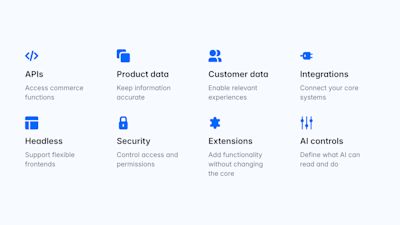
APIs, data, integrations, security, extensions, and AI controls support readiness.
What should ecommerce leaders look for in a Shopware architecture?
Selecting a platform is only the beginning.
The implementation decisions around that platform can determine how flexible the business remains over the next several years.
This is where businesses evaluating ecommerce development services should look beyond design and functionality.
A modern commerce architecture should be assessed across several layers.
Area | Questions to consider |
APIs | Which commerce capabilities are available programmatically? |
Integrations | How will ERP, PIM, CRM, WMS, and marketplaces connect? |
Data | Where is the source of truth for important information? |
Frontend | Can the customer experience evolve independently? |
AI | What information can AI access and what actions can it perform? |
Security | How are authentication and permissions managed? |
Extensions | Can new functionality be added without modifying the core? |
Operations | How will the architecture be monitored and maintained? |
Upgrades | Can the platform be upgraded without breaking integrations? |
Shopware's app system supports API-based extensions and its platform provides APIs for integrations and custom experiences. This approach can help businesses extend commerce capabilities while reducing direct changes to the platform core.
What should you ask a Shopware partner agency?
Do not only ask how quickly the agency can launch the storefront. Ask how it approaches architecture.
Questions worth asking include:
How will the commerce platform connect to our ERP and PIM?
Which integrations should be synchronous?
Where should business logic live?
How will customizations affect upgrades?
How will AI access commerce data?
What permissions will AI have?
How can we replace a third-party service later?
What happens when a new customer channel emerges?
Can we replace an AI provider without disrupting existing workflows?
How will you prevent integrations from creating long-term dependencies?
Can the architecture support future technologies without a major rebuild?
The answers can reveal whether the implementation is designed for long-term change or only for the immediate launch.
How can businesses prepare their Shopware architecture for AI?
Businesses can prepare by treating AI readiness as an architecture and data project rather than simply an AI software purchase. The first step is to understand which commerce data and functions AI will need. The next is to expose those capabilities through secure APIs and controlled services.
A practical five-step approach is:
Map the ecosystem Document Shopware, ERP, PIM, CRM, WMS, search, payment, analytics, marketplaces, and other connected systems.
Identify the source of truth Know which system owns each critical data set. Avoid creating multiple competing versions of product, pricing, customer, and inventory data.
Audit APIs Determine which capabilities can be accessed programmatically and where custom integration work is required.
Define AI permissions Separate what AI can read from what it can recommend and what it can execute.
Start with one measurable use case Choose a specific business problem. Measure the result before expanding AI across the commerce operation.
This approach keeps the technology conversation grounded in business value.
It also prevents AI from becoming another isolated tool sitting beside the commerce platform.
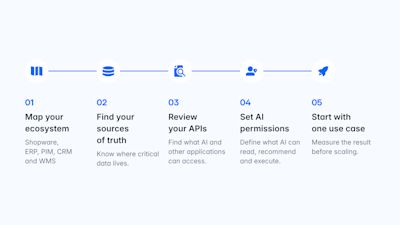
A five-step approach maps systems, APIs, data, permissions, and use cases.
Is open commerce architecture the future of ecommerce?
Open commerce architecture is becoming more relevant as ecommerce expands beyond traditional websites.
AI is one reason.
Customers are gaining new ways to discover and evaluate products. Businesses are experimenting with AI assistants, automated workflows, conversational commerce, and agent-led purchasing.
These experiences require access to commerce data and business capabilities.
That creates pressure on traditional architectures.
The answer is not necessarily to replace an existing commerce platform.
It may be to make the platform more connected, modular, and accessible.
Shopware's current direction reflects this movement toward open commerce infrastructure and agentic commerce. The company has also expanded its AI capabilities and composable tools as part of its broader platform strategy.
The bigger lesson applies across ecommerce platforms.
The most important question is no longer whether a platform supports today's channels. It is whether the architecture can adapt to tomorrow's channels.
What should ecommerce teams prepare for now?
It is better to concentrate on capabilities rather than predictions.
Build strong APIs.
Improve data quality.
Reduce unnecessary dependencies.
Separate customer experiences from core commerce logic where appropriate.
Define clear security controls.
Make AI access intentional rather than unrestricted.
These steps can support today's ecommerce needs while creating room for technologies that have not yet become mainstream.
What does open commerce mean for the next generation of ecommerce?
Open commerce is ultimately about keeping options open.
AI will continue to evolve. Customer behavior will change, and new channels will emerge. Businesses need architectures that can adapt without rebuilding their entire technology stack.
Shopware provides an API-first foundation and integration options to support this flexibility. However, the real advantage lies in how businesses design their architecture around it.
The next generation of commerce will not be defined by who adopts AI first. It will be shaped by who can adapt as technology changes.
The goal is not to predict what ecommerce will look like in five years. It is to build an architecture that can adapt when we get there.
Planning your next Shopware initiative?
Use these questions to assess whether your architecture is ready for AI-driven commerce. Partner with a seasoned Shopware development partner to build a flexible foundation that meets today’s needs and supports tomorrow’s innovations.

About the author: Ramanathan Ramakrishnamurthy
Ramanathan is a seasoned content writer at Ziffity Solutions, an IT services company. Specializing in digital trends, strategies, best practices, and technical insights, he collaborates closely with technical experts to deliver informative and engaging content. With over nine years of hands-on experience in ecommerce and digital technologies, Ramanathan brings a deep understanding of the field to his writing.