

Online stores have spent years serving people who browse and buy, but some of the requests arriving at those stores now come from AI agents acting for human customers.
In 2025, Columbia Business School researchers built a simulated marketplace to study what happens when AI agents do the buying, letting the agents choose among products without a person making the final selection. Consulting firm Deloitte has laid out how far this could go, ending with agent-to-agent commerce, where the shopper’s AI talks straight to the store’s AI without requiring the shopper to open a webpage at all.
Reaching that point will take time, but Shopware has already noticed a divide among merchants, since stores that prepared their systems for AI agents are moving ahead of stores that have not. Even so, a person still sits behind the purchase, and the number of steps left to that person keeps shrinking as software handles more of the transaction.
From AI-assisted shopping to autonomous commerce
It all starts with a simple change in who finishes the purchase. Software that suggests a product and software that buys one can look alike from the outside, but only one of them has permission to spend.
The first generation of AI shopping
Shopping tools have been useful for years without ever touching a checkout button. Early on, search filters helped shoppers narrow large catalogs by price or product features.
Over time, retailers added tools that used browsing or purchase history to recommend products, leaving shoppers with fewer choices to sort through. And more recently, chat assistants began answering product questions before checkout.
Bain describes the same progression as shopping AI moving from gathering information to acting more like a copilot, with generative AI changing how people find and compare products. But even then, the shopper still made the final decision and completed the purchase.
When software starts acting
The difference now is what the software is allowed to do once it receives instructions. Paul Krauss, Partner AI at Team One, points to tool use as the dividing line, describing it as a model's ability to control outside systems through structured commands. "A model that only generates text does not buy anything," Krauss said.
With that ability, agentic commerce extends from researching options to placing orders on behalf of the person who sent the request. And once an agent sends that order, the store still has to be ready to receive it.
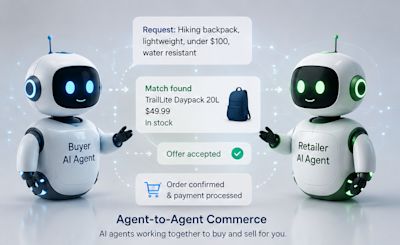
What Agent-to-Agent Commerce actually looks like
Agent-to-agent commerce starts with a purchase request that has to make sense to software on both sides. For example, a shopper looking for a laptop under $1,500 might add two requirements, giving the buyer's agent a clear set of conditions to carry into the transaction.
The consumer's agent
With those conditions set, the agent needs reliable product information from the seller. MIT's Initiative on the Digital Economy notes that agents need access to a retailer's shopping system before they can make a selection and move toward payment.
The merchant's systems
On the seller side, that request has to be answered with current information about what is available and whether the purchase can proceed. PwC calls that requirement being transactable, with checkout and fulfillment paths an agent completes on its own.
The "conversation" between machines
Little of that exchange resembles two chatbots trading messages, since both sides pass structured data through software connections instead.
Google says UCP gives agents one way to work with commerce systems, reducing the separate connections a store would otherwise need for every agent reaching out. And with that connection established, the shopper submits one request while the systems exchange the information needed to move the purchase forward.
Why Agent-to-Agent Commerce could change the rules of ecommerce
Human shoppers are emotional buyers influenced by design and branding, while an AI agent is more likely to judge whether a product meets the requirements it was given.
Search rankings could give way to agent recommendations
With the agent working from specific requirements, Deloitte describes automated buyers evaluating suppliers on factors such as cost and availability. And a product that satisfies those requirements remains competitive without depending as heavily on where it appears on a page.
The product page plays a smaller role
Product pages also play a smaller part in the purchase when an agent gets the information it needs directly from retailer data. Google has already added Merchant Center fields that give AI systems details beyond traditional keywords, including answers to product questions and compatible accessories.
Retailers therefore have more reason to make product details available outside the page itself, since the agent does not need the same visual path a shopper would follow.
Commerce could become more intent-driven
All of it traces back to the request someone gives at the start, which sets the limits the AI agent works inside. But the seller still needs proof that the agent is allowed to make a purchase under those limits.
The biggest challenge is trusting AI to spend money
Trust is by far the biggest hurdle facing autonomous shopping, especially when it comes to giving a computer program the green light to spend real money. Finding a product requires accuracy, but completing the purchase requires proof that the agent has authority to use the shopper's money.
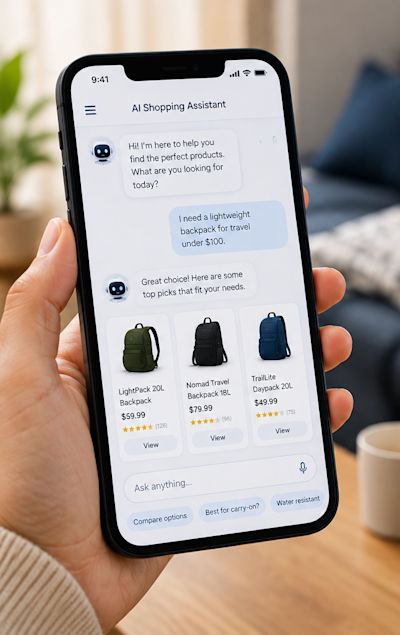
How much autonomy is too much?
Deloitte uses “workflow autonomy” to describe how much of a purchase software handles end-to-end. And as an agent handles more of the purchase, its permission has to be clear.
Who is responsible when an AI makes a mistake
However, giving the agent more authority also removes some of the human checks that might catch a wrong order before it goes through.
Bob Hedges, a fellow at MIT's Initiative on the Digital Economy and former Visa chief data officer, says formal rules already spell out who carries liability in a fraud case. And how those rules apply to AI agents remains under negotiation.
The importance of identity and payment
Still, any dispute over an AI purchase is easier to sort out when there is a clear record of what the shopper actually authorized. Google's Agent Payments Protocol records a shopper's instructions as signed mandates, giving merchants something to check before payment.
What merchants will need to prepare for
AI shopping agents are starting to send purchase requests directly to retailers, leaving merchant systems to supply the information needed to complete an order.
Clean, structured product data
PwC says agent-ready commerce depends on clean data and processes that agents can reliably act on. And that data only works if the product details are complete, since a missing size or compatibility detail can stop the software from confirming that a product actually fits the request.
Open and interoperable commerce systems
Even accurate product data only helps if an outside agent has a workable way to send the order. Team One AI partner Paul Krauss notes that without shared standards, every connection becomes an individual project that does not scale. Retailers then face the burden of building a separate connection for every agent that wants to place an order.
Business rules become more important
Opening merchant systems to outside agents also requires store policies that software can apply. PwC includes policy rules among the areas businesses should update for agentic commerce, including rules around discount eligibility and returns. And existing merchant policies will have to be clear enough for software to apply without guessing.
The future of shopping may be less about "clicking" and more about "delegating"
Given that technology now lets shoppers hand more of a purchase to software, delegation is starting to change how much of an online store a person needs to use directly.
Becca Coggins, a McKinsey senior partner leading the firm's global retail practice, calls agentic commerce a fundamental reconfiguration of the customer journey, with a shopper's digital proxy navigating the marketplace on their behalf. And handing more of that navigation to the AI agent reduces how many product pages and checkout screens a shopper has to handle.
But even with fewer screens involved, traditional storefronts still serve people who want to browse, while agent-led purchases give others a way to finish an order without the same trip through the store.
The new competitive question
Retailers now have to keep a browsable store running while their systems answer purchase requests from agents that never open it. But an agent-led purchase only works if the order can move from start to finish without sending the shopper back to correct a problem the software was supposed to handle.
Conclusion: The next customer may not be human
Perhaps the most surprising change is that some customer interactions now happen through an AI agent rather than directly with a person.
Mark Stanley, Chief Product and Technology Officer at Shopware, has described the core commerce platform as the place where transactions happen, and customer relationships form, with AI agents beginning to operate there too.
Agents taking part in those transactions make software the retailer's direct point of contact even though a person still authorizes the purchase. Even so, the customer relationship still belongs to the person who authorized it. And given where that relationship sits, merchants now have to recognize that serving the customer also requires responding to the software acting for them.