

Commerce orchestration brings your entire software ecosystem under centralized control. Instead of having each system – such as your ERP or PIM – communicate directly with your online store, an orchestration layer coordinates everything. It "knows" exactly what step to take next when a customer clicks "Buy," for example.
Commerce orchestration at a glance
The conductor of your IT: Commerce Orchestration coordinates all your tools (ERP, PIM, CRM, etc.) from a central location.
Real-time operations: The system responds immediately to events such as purchases or inventory changes.
You can replace or add individual software components (best-of-breed) without compromising the entire system.
Automated logic: Processes such as intelligent order routing or global inventory management run without manual intervention.
Cost and error reduction: You reduce manual data maintenance and technical debt through a decoupled, clean system structure.
Shopware: With Flow Builder and a consistent API strategy, Shopware offers you the perfect tools to get started with orchestration.
Why do I need commerce orchestration?
Commerce orchestration helps you manage the growing complexity of modern IT ecosystems. It is always helpful when different systems need to be coordinated simultaneously. Commerce orchestration breaks down data silos, prevents manual errors through automated workflows, and connects new channels or services.
Break down silos and synchronize in real-time
Perhaps you are familiar with this scenario: Your departments work with systems that do not communicate directly with each other. Your marketing department uses a CRM, your purchasing department uses a PIM, and your warehouse uses an ERP. Without orchestration, this leads to delays and data errors.
As soon as a piece of information changes, such as stock levels or a product price, the orchestration immediately distributes this change to all your connected channels.
Avoid overselling: By synchronizing inventory in real-time across all marketplaces and your own store, you prevent your customers from ordering items that are no longer physically available.
Shorter time-to-market thanks to commerce orchestration
If you want to introduce a new service, such as "Click & Collect" or a new AI chatbot, this often fails due to the rigid IT structure. With an orchestrated architecture, things are different:
Modular design: You don't have to reprogram the core of your store. Instead, you simply plug the new service into your existing orchestration layer.
Competitive advantage: You can implement new market trends in weeks instead of months because your systems are no longer tightly coupled.
Scalability and error prevention
Manual processes are not only expensive when order volumes increase, but also prone to errors. Orchestration automates these processes in the background.
Intelligent logic: The system independently determines which logistics partner is most cost-effective for a shipment or from which location a partial delivery will reach the customer the fastest.
Reduced IT workload: Since processes are controlled via a graphical user interface or rules, the IT department spends less time maintaining individual interfaces.
What are the core components of a commerce orchestration engine?
The core components of an orchestration engine are an API-first architecture for connecting third-party systems, event-driven logic for real-time response to business events, and centralized workflow management that automatically controls complex processes. Together, these elements form the technological foundation for linking data flows between services such as payment, logistics, and inventory management and executing them without manual intervention.
Order orchestration: Managing the order flow
At the heart of most orchestration engines is order management. This involves optimizing the path of a purchase from click to delivery.
Intelligent routing: The system automatically decides from which warehouse an order will be shipped in order to save shipping costs or shorten delivery times.
Order Splitting: Does an order consist of items located in different warehouses? The engine coordinates the splitting into multiple packages and keeps the customer informed about the status of each part.
Inventory Orchestration: Managing inventory
The goal here is to create a "single source of truth" for your inventory, regardless of how many warehouses or retail locations you operate.
Global inventory: The engine virtually combines all inventories. This allows you to sell items in your online store that are actually on the shelves of a physical store (omnichannel).
Buffer management: You can set rules so that once a certain amount of stock remains, an item will only be sold in your own online store and no longer on Amazon, in order to prevent overselling.
The role of AI: Predictive orchestration
Some engines are increasingly using artificial intelligence to proactively control processes.
Demand forecasting: AI identifies patterns and predicts increased demand in specific regions before it happens.
Dynamic logic: If a strike is announced at a shipping service provider, the engine can proactively switch the shipping route to another partner before delays occur.
How to implement your commerce orchestration with Shopware
Shopware acts as the flexible core of your commerce ecosystem, allowing you to set rules for pricing, shipping, and communication without writing code and to coordinate even complex data flows between your store and external tools such as ERP or PIM.
The Flow Builder as your graphical orchestrator
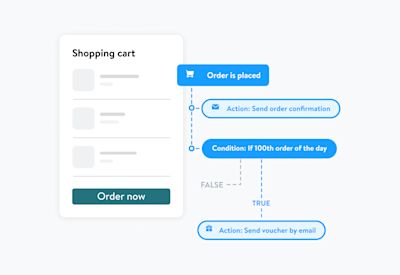
One of the most powerful tools for your orchestration is the Shopware Flow Builder. It allows you to visually model complex business workflows.
Automated processes: You can specify that a certain event (e.g., "order received") automatically triggers a series of actions in different systems, from sending a webhook message to your logistics provider to updating your CRM.
No coding required: Many processes that would have required a developer in the past can now be configured and customized yourself using drag-and-drop.
While Flow Builder controls processes, Rule Builder helps you define the conditions for them:
Contextual rules: You can define highly specific rules for customer groups, countries, or shopping cart values. These rules immediately affect your prices, shipping methods, or available payment terms.
Global consistency: Once defined, rules are applied across all your sales channels, so you can be sure that your business logic is consistent everywhere.
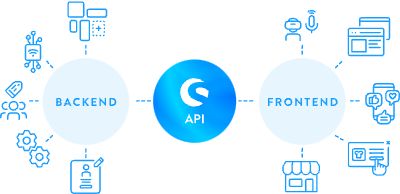
Shopware was developed according to the API-first principle. This means that every Shopware feature is available through an API.
Seamless integration: You can integrate best-of-breed solutions for search, payment, or marketing automation so deeply that they work as if they were native to your store.
Headless capability: You can use Shopware as a pure backend (commerce engine) and centrally orchestrate various frontends, from smartwatches to social media channels.
Discover Shopware!
Would you like to experience how you can intelligently orchestrate your business processes with Shopware? Discover the possibilities now in a personal demo or test Shopware for free.
Commerce orchestration – Frequently asked questions
What is the main advantage of commerce orchestration compared to middleware?
Traditional middleware primarily transfers data between systems through point-to-point integrations. Commerce orchestration, on the other hand, acts as an intelligent conductor. It makes real-time decisions and coordinates complex workflows across multiple systems instead of simply moving information from one application to another.
Does an orchestration engine replace my ERP system?
No. Your ERP remains the central source of truth for financial and inventory data. An orchestration engine sits on top of your existing technology stack, coordinating data flows between your ERP, online store, PIM, and external logistics providers. This allows you to automate processes such as order management without replacing your ERP.
Do small merchants need commerce orchestration?
If you're running a very simple setup with a single online store and one shipping method, your ecommerce platform may be all you need. However, once you start selling across multiple sales channels – such as your online store, Amazon, and a physical retail location – operate multiple warehouses, or integrate specialized business tools, commerce orchestration becomes a key driver of operational efficiency.
How does orchestration support international expansion?
Commerce orchestration makes it easy to connect country-specific services, such as local shipping providers or tax solutions. The orchestration engine automatically applies the correct regional rules and selects the appropriate partners for every order, allowing you to expand into new markets without rebuilding the core of your online store. Learn more about ecommerce internationalization.
What role does Shopware play in commerce orchestration?
Shopware serves as a highly flexible commerce core. With capabilities such as Flow Builder and its API-first architecture, Shopware already handles many orchestration tasks, helping you automate workflows and connect your commerce ecosystem efficiently.