


Modern commerce is no longer a binary choice between B2B and B2C. The most ambitious brands operate in a hybrid reality: manufacturers are launching direct-to-consumer channels to own the customer relationship, while digitally native D2C brands are expanding into wholesale to scale distribution. This convergence, however, is creating a profound architectural crisis. Many organizations find themselves trapped managing two disparate, disconnected systems – one for the agile, experience-driven D2C world and another legacy portal for the complex B2B sales motion. This dual-stack approach leads to fragmented inventory, duplicated administrative overhead, and a brittle, high-maintenance IT landscape. The cost isn't just financial; it's a strategic bottleneck that stifles growth and innovation. To truly master complex commerce, leaders must move beyond the siloed model and embrace a unified architecture designed for this new hybrid imperative.
The four collision points of hybrid commerce
Running two parallel commerce operations inevitably leads to friction where the distinct needs of B2B and B2C customers collide. These operational breakdowns are not edge cases; they are fundamental flaws of a disjointed architecture that hinder scalability and efficiency.
A visual diagram illustrating the four collision points: Pricing, Catalog, Checkout, and Fulfillment, with arrows indicating data conflicts and process friction between separate B2B and D2C platforms.
1. Pricing & contract complexity
Your D2C channel operates on a simple premise: a public Manufacturer's Suggested Retail Price (MSRP). Your B2B channel is a universe of complexity, governed by negotiated contracts, customer-specific price lists, tiered volume breaks, and group-based discounts. In a siloed model, managing this requires manual spreadsheet uploads or brittle ERP integrations, leading to quoting errors, lost margin, and a frustrating experience for your most valuable commercial buyers.
2. Catalog & assortment segmentation
Consumers should see your curated retail assortment. Verified commercial buyers, however, need access to a completely different catalog: specialized SKUs, bulk packaging options, internal spare parts, or restricted items. A dual-stack system forces you to manage two separate product information databases, doubling the effort for catalog updates and risking data inconsistencies that erode buyer trust.
3. Checkout & payment dichotomy
The checkout flow is where the needs of consumers and commercial buyers diverge most sharply. Retail customers expect speed and convenience with credit cards and digital wallets. Procurement officers require a completely different toolset: purchase orders, pre-approved credit lines, invoice payment terms, and multi-level approval workflows. Forcing a D2C checkout on a B2B buyer is a non-starter, while a clunky B2B portal alienates consumers. Without a unified system, you deliver a subpar experience to both.
4. Inventory & fulfillment logic
How do you balance inventory between a flash sale driving thousands of small consumer orders and a multi-ton bulk commitment for a key distributor? Disconnected systems cannot dynamically allocate stock, leading to stockouts for one channel while inventory sits idle for another. This fragmentation prevents a single source of truth for fulfillment, complicating logistics and jeopardizing both consumer satisfaction and B2B contract fulfillment.
The architectural blueprint: Unified multi-sales channel orchestration
The solution to hybrid complexity is not to manage two systems better; it's to consolidate them onto a single, flexible core. A true enterprise commerce platform provides the architectural foundation to orchestrate both B2B and D2C channels from one backend. This unified approach puts your team in the driver’s seat, allowing you to power your commerce with a platform that adapts to your strategy – not the other way around.
Capability | Two disparate stacks (siloed model) | Unified multi-channel hybrid architecture (Shopware) |
Product data | Duplicated catalogs; high risk of data inconsistency. | Single source of truth with channel-specific overrides. |
Pricing logic | Hard-coded B2B rules or manual spreadsheet management. | Dynamic rules engine evaluates buyer context in real-time. |
Order management | Fragmented order queues; manual reconciliation needed. | Automated workflows route orders based on channel rules. |
Customer experience | Inconsistent branding; clunky B2B portal, rigid D2C site. | Tailored frontends (headless) from a single commerce core. |
Single product master with inheritance
A unified core allows you to maintain one source of truth for all product data. Core attributes (name, base description, imagery) are managed once, while channel-specific properties (B2B-only SKUs, D2C pricing, wholesale descriptions) are applied as contextual overrides. This eliminates redundant work and ensures data integrity across your entire business.
Rule-driven business logic
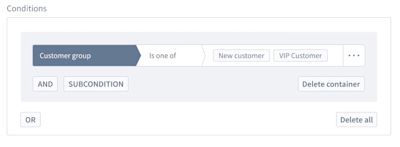
Instead of hard-coding thousands of pricing variations, a modern architecture uses a dynamic rules engine. With Shopware's Rule Builder, you can use a drag-and-drop interface to define conditions – such as customer group, cart value, or location – and trigger actions like displaying contract pricing, offering specific payment methods, or applying shipping discounts. This automates the complexity of B2B pricing and promotions without writing a single line of code.

Automated event routing
A unified system can differentiate orders based on their origin and automatically trigger the correct downstream processes. Using an event-driven tool like Shopware's Flow Builder, a D2C order can be routed to one fulfillment queue in your ERP, while a B2B purchase order can trigger an approval workflow and sync with a separate inventory system. This level of automation is impossible when systems are siloed.
Modular frontends/headless flexibility
A single backend doesn't mean a one-size-fits-all frontend. With an API-first foundation, you can build multiple heads for multiple channels. This allows you to deliver a sleek, consumer-grade shopping experience for your D2C site while providing a robust, feature-rich self-service corporate portal for B2B buyers – complete with tools for quotes, order history, and account management – all powered by the same commerce engine.
Resolving channel conflict: Turning traditional dealers into digital partners
One of the biggest fears in launching a D2C channel is cannibalizing your existing dealer and distributor network. However, a unified hybrid commerce strategy can strengthen these partnerships rather than undermine them. By orchestrating all channels from a single platform, you can create symbiotic relationships. A customer can browse on your D2C site, and a dealer locator can route them to a local partner for purchase or pickup (split fulfillment). You can attribute online sales to the dealer who influenced the purchase, creating a win-win scenario where your digital presence drives traffic and revenue for your physical partners.
Strategic roadmap: 4 phases to consolidate into a single hybrid stack
Migrating from a fragmented, dual-stack environment to a unified scalable ecommerce platform is a strategic initiative that requires a clear, phased approach. This roadmap outlines the critical steps to consolidate your operations and unlock true hybrid agility.
A clear, professional infographic illustrating a 4-step linear process. Each step should have an icon and a brief description as outlined below.
Phase 1: Catalog & ERP alignment.
The foundation of hybrid commerce is a unified data model. Begin by rationalizing your product taxonomy across both B2B and D2C channels. Identify the core attributes that will be shared and define the boundaries for channel-specific inheritance. This is the critical moment to ensure your ERP is the undisputed master for core data like stock levels and base product information.
Phase 2: Business logic rule definition.
Map out every commercial rule that governs your business. Document all tiered pricing structures, customer-specific payment terms, shipping restrictions, and approval workflows. Translate this logic into a comprehensive set of rules within your platform's rule engine, pressure-testing them against real-world customer scenarios.
Phase 3: Portal & sales channel deployment.
With data and logic in place, configure your distinct sales channels in the shared backend. Build out the consumer-facing D2C storefront and the B2B self-service portal. Configure the unique domains, currencies, languages, and checkout flows required for each channel, ensuring the customer experience is perfectly tailored.
Phase 4: Phased customer migration.
Avoid a risky 'big bang' cutover. Begin by onboarding a pilot group of trusted wholesale buyers to the new self-service digital portal. Gather feedback, refine the experience, and demonstrate value. Once the B2B portal is proven and adopted, you can run it live alongside your D2C channel, completing the consolidation.
Conclusion: Agility at scale is the future of complex commerce
Modern commerce leaders no longer have the luxury of choosing between consumer elegance and enterprise robustness. The market demands both. The anti-pattern of managing separate, siloed commerce stacks is a relic of a previous era – a costly and unsustainable model that creates more problems than it solves. A unified hybrid architecture is the strategic foundation for future growth. By consolidating onto a single, open, and flexible core, you can master complex commerce, streamline operations, and finally have a platform that adapts to your strategy, not the other way around. Move beyond the expected and build the future of your business on one powerful commerce platform.
Ready to unify your commerce operations?
See how Shopware's open, flexible platform can help you manage B2B and D2C complexity from a single core. Let's talk about your strategy.