
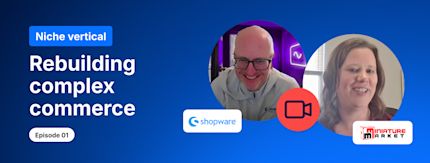
Scaling ecommerce is challenging. Scaling a niche business with highly specific requirements is something else entirely.
Companies like Miniature Market don’t just sell products. They serve a passionate community, manage thousands of SKUs, handle pre-orders, and at the same time need to deliver an experience that goes far beyond a traditional online store.
The real challenge isn’t growth itself – it’s the question: how do you scale without losing what made customers choose you in the first place?
This article is part of our series exploring how businesses handle complex ecommerce requirements – and how they turn that complexity into sustainable growth. Based on a conversation with Miniature Market, it distills the key insights for merchants managing sophisticated ecommerce operations.
Watch the full conversation in the video below, or keep reading for a quick overview of the most important takeaways.
About Miniature Market
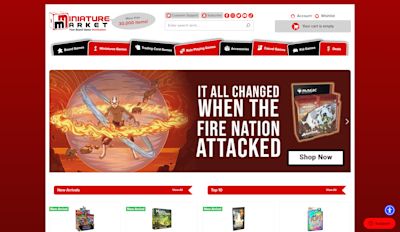
Miniature Market is much more than a traditional online store. Based in St. Louis, USA, the company is one of the best-known retailers in the tabletop, board game, and collectible card game space, with over 20 years of experience in this niche.
What makes Miniature Market stand out is not just its broad assortment, but above all its close connection to a global community of players and collectors. Its audience ranges from beginners to long-time enthusiasts – all united by a shared passion for games that bring people together.
In addition to its strong ecommerce business, the company also operates physical retail stores. This combination of brick-and-mortar retail and digital reach is a core part of the brand: while the stores create space for experiences and community, the online store provides access to a significantly larger assortment and an international customer base.
With a catalog of tens of thousands of products, frequent new releases, and a highly dynamic assortment, Miniature Market operates in an environment that is constantly evolving. This unique mix of community, product variety, and speed makes the company a compelling example of modern, complex ecommerce.
The challenge: When niche becomes complexity
What makes Miniature Market successful is also its biggest challenge: a business model that doesn’t fit into traditional ecommerce standards.
As a retailer in the tabletop and gaming industry, the company serves a highly engaged and demanding audience. Customers are often deeply knowledgeable, closely follow new releases, and expect an experience that goes far beyond a simple product search.
“We’re a hobby store with a very niche audience – and that brings a huge amount of complexity.” – Christina Smith, VP of Strategic Sourcing & Customer Experience, Miniature Market
A key factor is how the company handles pre-orders. New games are often announced long before their official release, with uncertain timelines and fluctuating availability. For Miniature Market, this means managing the expectations of both publishers and customers while maintaining full transparency at all times.
On top of that, the product assortment adds another layer of complexity. With more than 30,000 products – ranging from individual trading cards to large-scale strategy games – the catalog is not only extensive but highly dynamic. New titles are released regularly, trends shift quickly, and demand for older products remains strong.
The purchasing logic itself also differs significantly from typical ecommerce scenarios. Features like the “customer hold” program allow customers to delay shipments and combine orders later on – a capability that adds complexity to both the customer experience and internal operations.
At the same time, Miniature Market operates within a hybrid model that combines brick-and-mortar retail with ecommerce. While physical stores provide space for community, events, and hands-on experiences, the online store must extend this experience digitally and make it scalable.
All of this shows that the complexity does not stem from a single issue, but from the interaction of community, assortment, processes, and expectations. This is where the real challenge lies – and where any successful scaling strategy must begin.
The turning point: When the system becomes a barrier to growth
As the business continued to grow, it became increasingly clear that Miniature Market’s existing system landscape was reaching its limits.
For many years, the online store was built on a heavily customized Magento solution. What initially provided flexibility gradually turned into a challenge: numerous individual customizations led to a level of technical complexity that increasingly slowed down innovation.
New features that have long become standard in modern ecommerce – such as fast checkout options or additional payment methods – were difficult or even impossible to implement. At the same time, every new customization introduced the risk of breaking something elsewhere in the system.
“We had a system that was so heavily customized that every new integration carried the risk of breaking something else,” says Christina Smith.
At the same time, internal effort continued to grow. Teams spent more and more time finding workarounds or trying to make existing processes technically feasible in the first place. Tasks that should have been simple became unnecessarily complex – preventing teams from focusing on more important priorities.
Meanwhile, customer expectations kept rising. New payment options, faster processes, and more flexible purchasing experiences were no longer optional features, but expected as standard.
For Miniature Market, it became clear that this was no longer about optimizing the existing system – it required a fundamental reset. “We needed a clean, stable foundation that would allow us to grow and bring new ideas to life,” Christina explains.
This marked the turning point: a move away from a historically grown system toward a platform that can not only handle complexity, but actively support it.
How Miniature Market rebuilt its commerce setup
Moving away from the existing system was more than just a technical change for Miniature Market. It was about creating a foundation that could not only handle existing complexity, but actively support future growth.
At the center of this transformation was the decision to adopt a modern, flexible ecommerce platform – combined with a system setup that treats integrations not as a risk, but as a strength.
A key factor in this approach: how well the individual systems work together.
Miniature Market relies on a wide range of specialized tools – from warehouse management to marketing automation and customer service. Solutions like ShipHero for logistics, Klaviyo for email marketing, and Zendesk for customer support each play a central role in daily operations.
However, the real value does not come from the individual tools themselves, but from their seamless integration. Only when data flows consistently between systems do the efficiency and transparency required for scalable ecommerce emerge.
“These systems don’t work in isolation. What matters is how well they are connected and how effectively they work together.” – Christina Smith, VP of Strategic Sourcing & Customer Experience, Miniature Market
With its new technical foundation, Miniature Market was able to address exactly this: moving away from individual workarounds toward a setup designed for scalability and stability.
At the same time, the way teams work has evolved. Instead of spending time on technical workarounds, teams can now focus more on what truly creates value: new campaigns, better customer experiences, and creative ideas.
A concrete example of this is the checkout process. New payment methods such as Apple Pay or Google Pay – previously difficult to implement – can now be integrated much more easily, improving conversion across the entire customer journey.
Marketing capabilities have also expanded. Campaigns, promotions, and new features can be tested and rolled out more quickly, without every change requiring deep intervention in the system logic.
“Today, it’s much more about creating possibilities – and simply being able to try out new ideas,” says Christina Smith.
This shows that the real transformation is not just about the technology itself, but about what it enables: a setup that structures complexity instead of blocking it – and empowers teams to continuously evolve.
What has actually changed
The new technical foundation has not only improved individual processes at Miniature Market – it has changed the way the company operates and grows.
One of the most noticeable differences is speed. New ideas can now be implemented, tested, and further developed much more quickly. What used to be slowed down by technical limitations is now part of a continuous improvement process.
Instead of spending long periods implementing individual features, the team can now take an iterative approach: test, learn, optimize.

Operations have also become significantly more streamlined. Thanks to better-integrated systems and clearly structured processes, workflows have become faster and more transparent. This applies to both internal operations and the customer experience.
Customers benefit, for example, from:
faster ordering processes
more flexibility at checkout
an overall smoother shopping experience
At the same time, the foundation has been laid to unlock new sales channels and opportunities – whether through additional payment methods, new marketing approaches, or future innovations in AI and commerce.
Another important impact can be seen within the team itself. The focus has shifted from reactive problem-solving to proactive development.
“Today, we can focus much more on testing new ideas and continuously improving what we offer,” says Christina Smith.
This makes one thing clear: the real value lies not only in more efficient processes or new features, but in the newly gained ability to continuously evolve. Miniature Market has created a foundation that not only supports current growth – but is flexible enough to meet future demands.
Key learnings: What other businesses can take away
The Miniature Market case shows that complexity in ecommerce is not the exception – it’s the reality for many business models. What matters is how companies choose to handle it.
The key learnings at a glance:
1. Complexity is not a problem – if it is structured properly
Whether it’s large assortments, pre-orders, or custom processes, complexity often stems from real customer needs. Instead of simplifying or avoiding it, businesses should learn to structure it in a way that makes it scalable.
2. Technology should enable growth – not slow it down
A system that has grown over time can eventually become a limitation. If new features are difficult to implement or innovation is blocked, it’s time to rethink the technical foundation.
3. Integration is the key to scalable ecommerce
The success of modern commerce setups doesn’t lie in individual tools, but in how they work together. Only through seamless integrations can businesses build systems that are efficient, flexible, and future-ready.
4. Speed becomes a competitive advantage
The ability to quickly test and implement new ideas is increasingly critical in ecommerce. Businesses don’t need to get everything right from the start – but they need to continuously improve.
5. Growth should not come at the expense of customer relationships
Especially in niche markets, the connection to the community is a key success factor. Scaling doesn’t mean standardizing everything – it means strengthening what makes a business unique.
Conclusion: Turning complexity into a driver of growth
The Miniature Market case shows that complex ecommerce is not a special case – it’s a reality for many businesses.
The key is not to avoid complexity, but to structure it in the right way. With the right technological foundation and a clear focus on integration, flexibility, and customer experience, complexity can become a true competitive advantage.
For companies looking to grow in dynamic markets, this means: the most successful businesses are not the simplest ones – but those that know how to manage their complexity.
Further reading
Want to dive deeper into complex commerce or explore practical approaches for your own business?
Learn more about Miniature Market’s success story in our case study
What is complex commerce – and how can it be managed successfully? Read the blog post
Discover how Shopware can support you in scaling your ecommerce business → product tour