


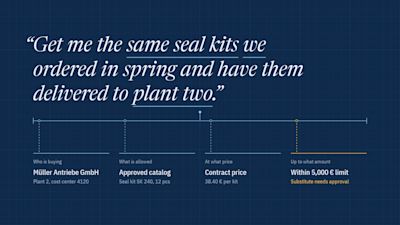
Picture a maintenance lead at a mid-sized manufacturer. It's Tuesday morning, a machine on line four is down, and she types into her assistant: "Get me the same seal kits we ordered in spring and have them delivered to plant two."
For her, that's one sentence. For an AI agent, it's a dozen decisions she never has to consciously make. Which legal entity is ordering? Which supplier contract applies? Is that exact part still in the assortment her company is allowed to buy? What happens if it's out of stock, is a substitute acceptable or not? Does "plant two" mean the address in the ERP or the one her colleague added to the shop last month? Is the order within her budget, or does her plant manager need to sign off first?
A human buyer answers all of that without thinking. An agent has to get every single answer right, explicitly, every time.
That's the part of the AI agent conversation I think we're still underestimating in B2B. Most of what we see today is built around a consumer picture: someone asks an assistant for the best running shoes under a certain budget, the agent compares a few options, and the purchase happens in a chat window. It's impressive. It's also a completely different problem from the one B2B merchants and buyers actually have.
In this article I want to look at agents from both sides of a B2B transaction, the buyer and the merchant, and explain why customer context isn't a nice to have in this world. It's the whole game.
Why B2B buying was never about finding products
Let's start with a simple observation. In consumer commerce, discovery is the hard part. People don't know exactly what they want, they browse, compare, get inspired. Agents are genuinely useful there because they compress that search.
Professional buyers work differently. Most of what they order, they have ordered before. They know the part numbers. They know which supplier delivers reliably and which one always needs a reminder. They know that the cheaper alternative looked good on paper but caused trouble in production two years ago.
Their problem isn't finding. Their problem is everything around the order:
Re-entering line items from an old PDF or an email thread
Checking whether the price on the order confirmation matches what was negotiated
Chasing approvals from someone who is traveling this week
Making sure the goods go to the right site, on the right cost center, with the right reference number so accounting doesn't send it back
If you've ever spent time with a procurement team or a purchasing assistant in a manufacturing company, you know how much of the day goes into this. It's not strategic work. It's administration that exists because B2B transactions carry a lot of context, and today humans carry that context from system to system.
That's exactly where an agent could help. But only if it carries the context too.
The buyer's perspective: useful only if trustworthy by default
When I think about what a B2B buyer expects from an agent, it comes down to one thing: it has to be right without being checked every time. Otherwise it's just another tool that creates work.
And the stakes for the buyer are personal. If an agent orders the wrong item, at a price nobody agreed to, shipped to the wrong site, it's not the agent that gets the call from finance. It's the buyer. If the order exceeded a limit, it's the buyer who has to explain why the approval process was skipped. If the invoice doesn't match the contract, it's the buyer who spends an afternoon clarifying it with the supplier.
One experience like that and they're back to email and phone. And trust in B2B is slow to rebuild. Buyers remember the supplier portal that showed wrong prices three years ago. They'll remember the agent that ordered the wrong seal kit too.
So for a buyer, the question isn't "how smart is the agent?" It's:
Does it know which company and which site I'm buying for?
Does it only show me what I'm actually allowed to order?
Does it use my prices, not some generic number?
Does it respect my limits and my company's approval rules?
Does it tell me clearly when it's unsure, instead of guessing?
That last point matters more than it sounds. A good human colleague knows when to stop and ask. A good agent has to do the same, and that only works if the rules it's working against are explicit.
(AI generated image)
The merchant's perspective: your advantage lives in the contract
Now switch sides. Think about a distributor or manufacturer selling to hundreds or thousands of business customers.
Over the years, that merchant has built a highly specific setup for each account. Individual price lists. Customer-specific assortments. Payment terms that differ from customer to customer. Multiple delivery addresses, often per site or per department. Different roles within the customer's organization: one person can browse, another can order, a third has to approve anything above a certain value.
Some of this lives in the ERP. Some of it lives in the shop. Some lives in the CRM. And a surprising amount lives in people's heads. The key account manager who knows that one customer always gets free shipping to their site in Austria. The inside sales rep who knows which article number a customer really means when they write something vague in an email.
In a world where the buyer logs into the merchant's shop, a lot of this works reasonably well. The login establishes who the buyer is, and the shop applies the right catalog and prices. Where the system falls short, a human steps in and fixes it.
Now imagine the buyer isn't logging in. Their agent is talking to your systems, or worse, looking at your public information without any customer context at all.
What does it see? Your full catalog. Your list price. Maybe some availability data. Or worst case nothing because everything is behind a login
Could be that the agent compares your list price with a competitor's list price and moves on. Every discount you negotiated, every framework agreement, every bit of value you built into that relationship becomes invisible at the exact moment a purchasing decision is made.
This is the point I find most important for merchants to understand. In B2B, the competitive advantage often isn't the product. Many distributors sell overlapping assortments. The advantage is the contract, the service, the terms, the relationship. If agents can't see the contract, that advantage simply disappears from the decision.
There's a second risk too. If customer-specific information isn't properly scoped, you might expose things you shouldn't. A price that one customer negotiated is not something you want another customer's agent to find. In B2B, getting context wrong isn't just inaccurate. It can be a commercial problem.
Context isn't personalization. It's correctness.
In consumer commerce, knowing the customer makes the experience nicer. Better recommendations, a saved address, maybe a loyalty discount.
In B2B, knowing the customer decides whether the transaction is valid at all.
Every agent request in a B2B setting needs four answers before anything meaningful can happen:
Who is asking? Not just the person, but the company, the site, the department or cost center they're acting for.
What are they allowed to buy? Their specific assortment, not the full catalog. Including rules for substitutes and blocked items.
At what price? Under which contract, which quantity tier, which currency, which payment terms.
Up to what amount can they commit? And who needs to approve anything beyond that.
None of these questions are new. They're the foundation B2B commerce has always been built on. Company accounts, organizational units, employee roles, individual pricing, budgets and approval workflows exist precisely because business buying is delegated buying. The person placing the order is rarely the one who owns the money.
What agents change is that they remove the human who used to fill the gaps. If your organizational structure is modeled cleanly in your system, an agent can work with it. If it only exists as a combination of system data and human judgment, the agent will get exactly the system half, and nothing else.
A prompt is a suggestion. A permission is a rule.
When companies start experimenting with agents, there's a very natural temptation: put the business rules into the agent's instructions.
"Never order more than €10,000 without approval." "Only use articles from the approved catalog." "Always deliver to the main warehouse unless told otherwise."
As guidance, that's fine. As the only safeguard, it's dangerous.
Instructions can be misunderstood, overridden by a cleverly phrased request, or simply lost when someone changes the setup. They also only apply to that one agent. The moment you add a second channel, a second agent, or a new integration, you need to copy the same rules again, and keep them in sync forever.
Budgets, contract prices and approval thresholds belong in the commerce system itself. They have to be enforced there, no matter where the request comes from: the storefront, a procurement system, an API integration or an AI agent. The agent should be able to ask "am I allowed to do this?" and get a reliable answer. It should never be the place where that answer is decided.
And one more principle I feel strongly about: an agent should never be able to change those rules on its own. If it notices that a threshold is causing constant friction, or that a customer keeps ordering a substitute, great. It should surface that to a human as a suggestion. It should not quietly adjust the rule to make its own job easier. Guardrails that the agent can modify aren't guardrails.
The best B2B agent flow isn't full autonomy
A lot of the conversation around agents focuses on autonomy. The agent that does everything by itself, end to end, with no human involved.
In B2B, I think that's the wrong goal for most use cases. Not because it's technically impossible, but because it doesn't match how business buying works. Companies deliberately put humans at certain points in the process. Not to slow things down, but because someone has to be accountable for spending the company's money.
The flow I believe will deliver the most value for most B2B buyers looks more like this:
"I've prepared your order: 12 seal kits at your contract price, delivery to plant two by Thursday. It's within your limit, but one item is a substitute for a discontinued part, so I need your OK before I place it."
Look at what happens here. The agent does all the tedious work: finds the previous order, checks the current assortment, applies the right price, checks delivery options. The system checks the rules: budget, entitlement, substitute policy. And the human only gets involved at the one point where judgment actually matters.
That's not a compromise between automation and control. It's exactly how well-run B2B organizations already work, just much faster and with far less admin.
Over time, some flows will become fully autonomous. Recurring reorders of standard items within clear limits are an obvious candidate. But that autonomy should be earned through reliable rules and transparent behavior, not assumed from day one.
Not one agent, but many
It's also worth being clear that "the agent" in B2B is rarely a single thing. There are at least three kinds that will show up in a typical transaction:
The buyer's own agent
, running inside their company, connected to their procurement processes and approval rules. It knows the internal side: budgets, cost centers, who needs to sign off.
The merchant's agent
, for example an assistant in the B2B shop or a sales agent supporting quotes. It knows the supplier side: assortment, contract prices, availability, delivery options.
Agents inside existing procurement systems
, which many large buyers already use as their central point of purchasing.
In practice, these will increasingly talk to each other. And that makes context even more important. When a buyer's agent hands a request to a merchant's system, both sides need a shared understanding of who is acting, for whom, and with what authority. If that handover is vague, every downstream decision becomes guesswork.
For merchants, this also means something practical: meet buyers where they already buy. If a customer's purchasing runs through a procurement system or a punchout connection today, that's likely where their agents will show up first as well. The integrations many merchants see as a legacy requirement may turn out to be the most important on-ramp for agent-driven orders.
What I'd focus on as a merchant right now
You don't need to redesign your entire B2B platform for autonomous buyers tomorrow. But there are things worth doing now, because they pay off regardless of how fast agents arrive.
1. Make your customer context accessible to machines.
Customer prices, catalogs and permissions need to be available through clean, reliable, current interfaces. If the correct price for a customer only exists after a nightly export from the ERP, an agent working in real time will either be wrong or have to wait.
2. Be clear about which system owns what.
If the shop, the ERP and the CRM give three different answers about a customer's price or delivery address, a new channel doesn't solve that. It multiplies it. Every agent you add inherits the same inconsistency.
3. Separate "may see" from "may commit".
An agent, or an employee, can be allowed to look up prices, check availability and prepare a cart without being allowed to place the order. Many B2B setups treat access as all or nothing. Agents make the in-between states much more valuable.
4. Treat approvals as a core feature.
Not as an edge case you bolt on later. Approval workflows are where human accountability and automation meet. If they're solid, agents can do much more without anyone getting nervous.
5. Get the tribal knowledge out of people's heads.
Every rule that only your key account manager knows is a rule no agent will ever apply. The free shipping arrangement, the blocked article for one subsidiary, the customer who always needs a specific reference on the invoice. If it matters, it needs to be in the system.
6. Keep a full trail.
Who asked for the order? Which agent acted on it? Which rules were checked? Who approved? When something goes wrong, and eventually something will, both buyer and merchant need to be able to reconstruct what happened. Without that, trust breaks at the first incident.
What buyers can do
This isn't only on merchants. Buying organizations also have homework if they want agents to work for them:
Model your organizational structure properly in your supplier accounts. Who can order, who approves, which sites and cost centers exist.
Define clear policies for substitutes, limits and exceptions, so an agent has something explicit to work with.
Start with low-risk, high-frequency purchases where the rules are clear and the pain of manual work is highest.
Insist that any agent you use can explain what it did and why.
The companies that get the most out of agents will be the ones that already have their purchasing house in order.
The bottom line
The B2B platforms that win with AI agents won't necessarily be the ones with the smartest model. They'll be the ones that can reliably tell a machine four things for every request: who is asking, on whose behalf, at what price and up to what amount.
The encouraging part is that this isn't new work. It's the same B2B foundation many of us have been building for years: clean customer accounts, organizational structures, individual pricing, budgets, approvals. If you've invested in that, you're closer to being agent-ready than you might think.
If you haven't, agents will make that very visible, very quickly. Because they don't fill gaps the way people do. They just expose them.
So here's the question I'd leave you with: if a machine instead of a person placed an order on your platform tomorrow, would it get the right products, at the right price, within the right limits?
I'd genuinely like to hear how far along you see your own setup.